 Cloud & Business Apps
 Cybersecurity
 Data & AI
 IoT & Connectivity
 Industry
 Health
 Banking and Finance
 Public Sector
 Retail
 Tourism and Leisure
 Transport & Logistics
 Energy & Utilities
 Smart Cities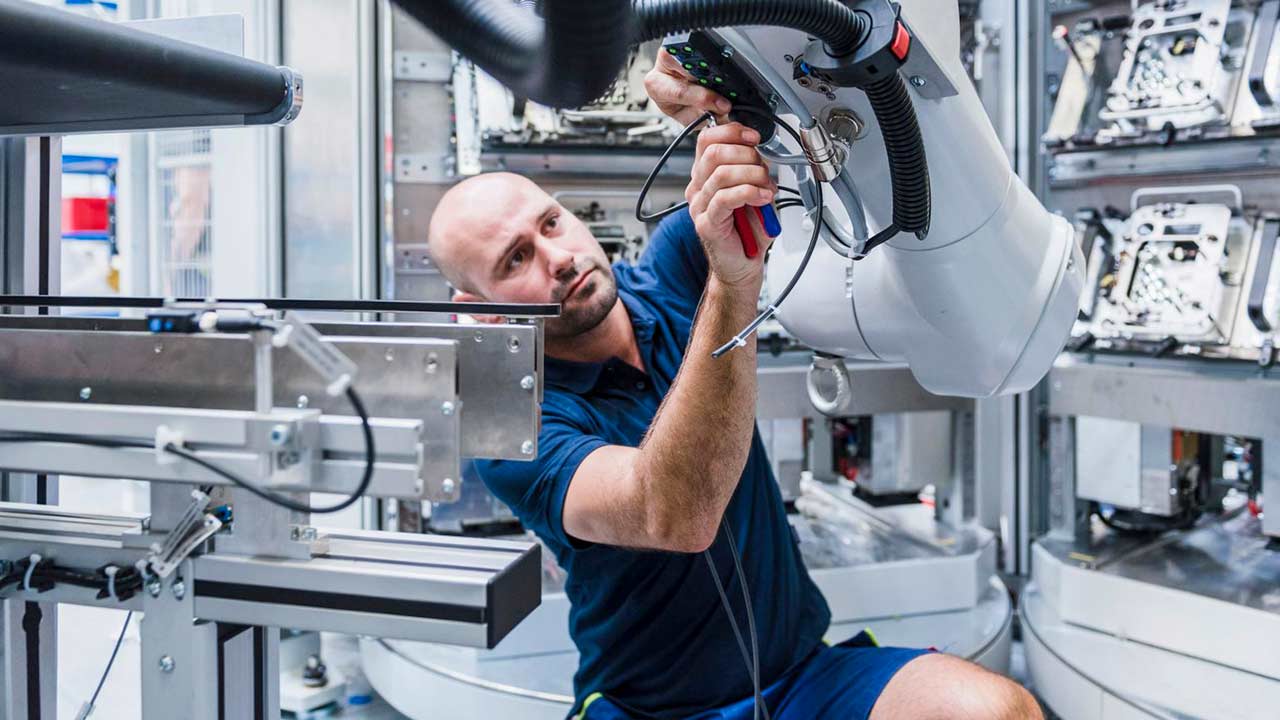

Physical AI: when Artificial Intelligence leaves the screen and enters industrial processes
We often repeat that Artificial Intelligence without data is nothing. But it is worth remembering: without structured, connected and governed data, AI models cannot be trained robustly or generate inferences that deliver real business impact. Without that foundation, they can process information, yes, but they will hardly produce useful decisions.
Fortunately, that stage is already quite advanced in many industries. In recent years, production plants have begun to organize their data, interconnect processes and digitalize assets. Now that we have the data, the question is what happens when that intelligence leaves the screen and begins to directly influence machines, robots and physical and logistics systems.
That is where we begin to talk about Physical Artificial Intelligence, or physical AI.
Physical AI begins when data stops describing reality and starts acting on it to transform it.
From programmed precision to continuous adaptation
Traditional industrial robotics has been effective in stable environments. Its strength has been exact repetition under controlled conditions. However, that precision depends on one premise: the context does not change.
The problem is that reality does change, and it does so constantly.
In any plant, variations in raw materials, small deviations in tolerances, shifts in demand or unexpected incidents are common. In a traditional framework these situations require stopping processes, readjusting parameters or reprogramming equipment,
Physical AI introduces a different logic. Analytical models are integrated into operations, allowing the robot to adapt its behavior based on real time data. The robot does not execute a closed instruction but adjusts its actions within defined limits according to the operational context it is reading at every moment.
The real difference lies in doing the same thing differently when the context changes.
This means that the system can recalibrate itself without stopping the line when facing parts with minor defects or changes in production conditions. The impact is real: less programming time, fewer interruptions, less waste and operational flexibility that shifts from being reactive to becoming adaptive and contextual, thereby reinforcing business continuity.
Physical AI and traditional automation: what is the difference?
It is worth pausing here, because physical AI is not an advanced version of the industrial automation we already know. It is not about adding more rules, sensors or programming. The difference is that the system does not execute predefined instructions but rather integrates models capable of interpreting historical and real time data, adjusting its behavior within operational margins.
Physical AI consists of incorporating decision making capabilities into the production process.
It works as a continuous cycle: it captures information from the environment, analyzes it, makes a decision, acts and captures data again to validate or correct its actions. This feedback turns operations into an adaptive process, into a system that continuously adjusts to environmental variability.
■ Beyond being a one off improvement, physical AI introduces a dynamic of continuous learning and adjustment that transforms the way we understand industrial automation.
When the digital acts on the physical
Until now, much of the AI applied in business environments operated within the IT domain. Systems that processed data, automated informational decisions or optimized digital flows.
Physical AI operates in a different domain.
We are talking about systems that analyze information and, based on it, act on the material environment: sensors that capture process variables and actuators that modify the behavior of robots, assembly lines or autonomous vehicles. This interaction turns these environments into cyber physical systems, where the integration between the digital and the physical ceases to be theoretical and becomes operational.
Here, an algorithm does not just calculate: it acts. And acting implies assuming consequences.
The difference is significant. A failure or incident no longer affects only the integrity or availability of information. It can halt production, cause material damage and even put people’s safety at risk or generate operational risks.
■ The design of these environments must incorporate from the outset a comprehensive vision of operations and security, where Cyber Security ceases to be a perimeter and becomes part of the system’s very design.
Security and operations: protecting what must not stop
The greater the autonomy of systems, the greater the responsibility to protect them. In environments where AI acts directly on physical processes, Cyber Security cannot be an isolated element, must be integrated into the operational logic itself.
In this context, beyond detecting threats, it is about understanding which production process is at risk, what impact a shutdown would have and which decisions should be prioritized to ensure continuity. Security is no longer measured solely in technical terms but is assessed in terms of operational impact.
This is where an approach such as our Telefónica Tech Mission Critical SOC becomes relevant, designed for industrial environments and cyber physical systems. The difference compared to a traditional SOC lies in several key aspects:
- Operational context: each incident is analyzed not only from a technical perspective but also for its effect on production.
- Controlled trust: secure management of remote and third party access in industrial environments.
- Assured continuity: prioritization of responses to keep operations running.
- Integrated governance: integration of multiple technologies under coordinated protection, detection and response procedures.
In a physical AI scenario, where digital systems act on the material environment, this approach shifts from being advisable to becoming indispensable. Protecting data is important, but protecting operations is critical to business continuity.
In production environments, protecting data is important and ensuring operations is critical.
The technological foundation that makes it possible
The application of physical AI does not begin with the algorithm. It begins much earlier and requires a connectivity infrastructure capable of interrelating assets, lines and plants, systems to store and govern large volumes of data and platforms to analyze them in real time. Without that prior architecture, introducing advanced models is ineffective and hardly sustainable over time.
In addition, it involves integration between automated systems and analytical platforms to effectively transfer model results to the production process. And it requires protection of both data and machines, because in these environments business continuity depends on the robustness of the infrastructure and the responsible use of applied intelligence.
■ It is not, therefore, about incorporating technology in isolation but about progressing through the necessary stages in the right order, consolidating each layer before moving on to the next.
Attempting to apply physical AI without having consolidated connectivity, data governance and protection is building on an unstable foundation.
Production and logistics: when adaptation becomes structural
In production, physical AI enables a line to adapt to variations in demand or changes in raw materials without constant intervention. Robots can identify anomalous patterns and anticipate failures through continuous analysis of their own operational parameters. Maintenance is no longer limited to anticipating breakdowns and evolves toward autonomous and prescriptive schemes, where the system, beyond detecting the problem, recommends or executes specific adjustments to prevent it.
The impact on internal logistics is equally significant. AGVs, or automated guided vehicles, can move away from static routes and adjust their trajectories according to the actual state of the plant. If an incident or bottleneck arises, the system reorganizes routes to maintain operational flow. The logic now is to optimize flow based on what is happening at every moment.
A factory that adapts in real time stops reacting to problems and starts anticipating them.
More than advanced automation
Physical AI is not just additional software layered onto existing robots. Nor is it simply another layer of technology on current infrastructure. It involves integrating data, models and the ability to act within a single industrial operating system. Therefore, beyond technology, it changes the way the plant responds to variability thanks to the incorporation of intelligence into the operational flow itself.
The system incorporates learning and adaptation into its operation instead of relying on static programming and manual adjustments. This continuous adjustment capability, data driven and protected by design, opens up new possibilities for efficiency and resilience in industry.
The challenge now is to redesign operations so that AI models act with sound judgment, security and coherence with the physical environment. Doing so in an orderly and secure way, aligned with the material reality on which they will act, is what determines whether we are facing a technological improvement or a true industrial transformation.
■ This article is based on the session Reinventing industry with physical AI held at MWC, in which our Telefónica Tech experts addressed the challenges, opportunities and technological keys to integrating AI into critical industrial environments, as well as the role of connectivity, Cyber Security and our Mission Critical SOC model in this new paradigm.