 Cloud & Business Apps
 Cybersecurity
 Data & AI
 IoT & Connectivity
 Industry
 Health
 Banking and Finance
 Public Sector
 Retail
 Tourism and Leisure
 Transport & Logistics
 Energy & Utilities
 Smart Cities

Protection against 'carpet bombing' DDoS attacks: a sophisticated threat to enterprise networks
In today’s Cybersecurity landscape, distributed denial-of-service (DDoS) attacks continue to evolve into more sophisticated, distributed and harder-to-detect attack techniques, increasing their potential impact.
Among them, 'carpet bombing' stands out as an advanced technique designed to overwhelm enterprise networks. Its complexity and distributed nature make it difficult to detect and mitigate using traditional methods.
This article explores what these attacks are, why they are particularly challenging for traditional detection mechanisms and how they can be addressed through an AntiDDoS protection approach that combines network visibility, automation and, where required, both on-premises and service provider capabilities.
What is a 'carpet bombing' DDoS attack?
A 'carpet bombing' attack is a type of denial-of-service attack in which malicious traffic is distributed across multiple IP addresses within the same network or IP address range. The volume directed at each IP address may remain below the usual alert thresholds, but the combined traffic across the entire network can saturate network links and degrade service availability.
Unlike traditional DDoS attacks, which typically target a single destination, this type of attack has several key characteristics:
- Large-scale distributed attack: traffic is spread across multiple victim IP addresses rather than concentrated on a single one.
- Network-wide saturation: the objective is not a specific service but the network links or infrastructure as a whole.
- Efficient use of traffic: each destination receives a relatively low volume of traffic, but the aggregated total is enough to overwhelm the network.
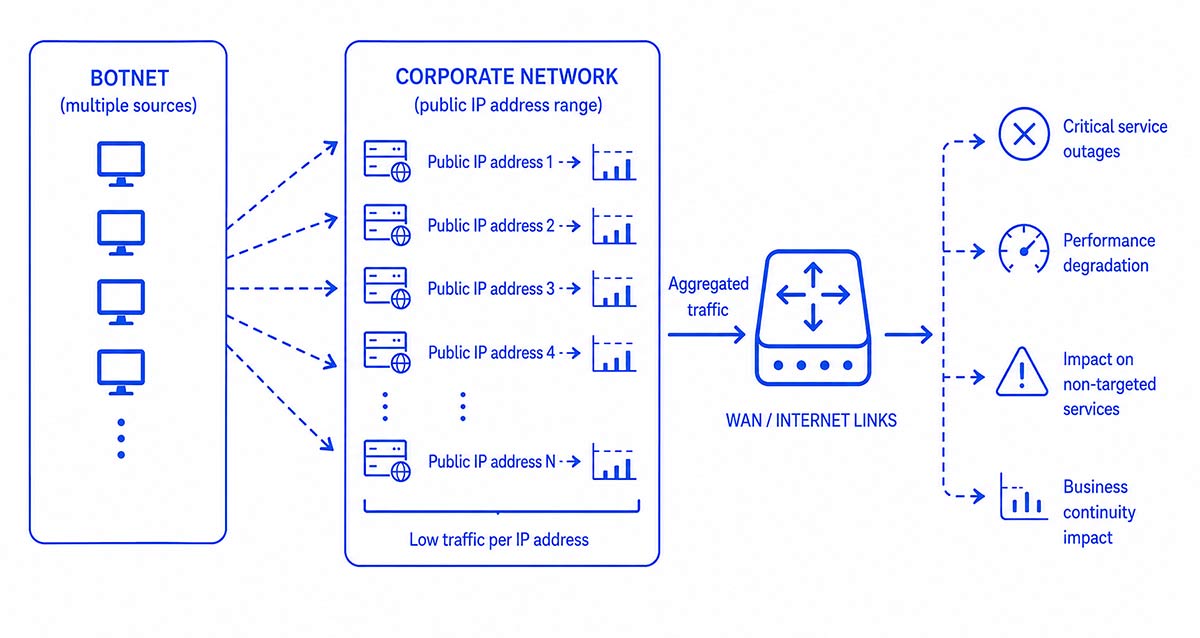 'Carpet bombing' DDoS attack flow
■ This approach enables attackers to evade detection mechanisms based on individual thresholds, making the attack particularly effective and difficult to detect.
Challenges posed by 'carpet bombing' attacks
'Carpet bombing' attacks present a significant challenge for enterprise security because of their distributed and evasive nature.
The main challenges include:
High risk to infrastructure
The attack can disrupt critical services, including those that are not being directly targeted, by saturating network links.
Detection challenges
Traditional solutions typically monitor traffic on a per-destination basis. However, because the attack is distributed, traffic directed at each IP address may remain below alert thresholds.
Need for a holistic view
It is essential to analyse traffic as a whole in order to detect suspicious increases across the network.
Simultaneous mitigation across multiple targets
Defending against these attacks requires tools capable of responding dynamically across multiple destinations at the same time, adapting as the attack evolves.
How to mitigate 'carpet bombing' attacks
Telefónica's managed AntiDDoS service addresses this type of attack through an advanced approach based on automation, global threat intelligence and Artificial Intelligence.
Network-wide traffic analysis
A network-wide analysis of traffic is carried out, making it possible to detect patterns of misuse that would not be visible when analysing traffic at an individual level.
Threat intelligence (ATLAS)
Netscout's global intelligence sources are used to identify known botnets, compromised proxies, malicious Tor nodes and active attack infrastructure.
Use of Artificial Intelligence
AI and machine learning can help identify changes in attack patterns, reducing the need for manual intervention and shortening response times.
Automated mitigation
The system can apply dynamic countermeasures and adjust mitigation across specific ranges or subnets as the attack distribution changes.
Integration with global threat intelligence
Real-time threat intelligence from multiple sources is combined to apply more accurate and effective countermeasures.
Benefits of AntiDDoS protection
Adopting advanced protection against 'carpet bombing' attacks delivers significant benefits for organisations. The key advantages include:
- Improved business continuity, even during large-scale attacks.
- Reduced operational workload and improved efficiency through automation.
- Lower risk of critical service outages.
- More precise and less intrusive mitigation than traditional solutions.
- Scalability to support networks of different sizes.
Evolution: towards hybrid protection
One of the most significant developments is the adoption of hybrid architectures, which combine the service provider's mitigation capabilities for volumetric attacks with on-premises infrastructure capable of continuously analysing traffic and responding close to the customer's network perimeter.
This approach enables:
- The option to incorporate encrypted traffic (SSL) inspection and advanced malware detection.
- Greater effectiveness in detecting complex attacks, including multivector and 'carpet bombing' attacks.
- Integration of multiple layers of protection, with automatic synchronisation of mitigation lists.
- Detection of outbound attacks originating from the data centre itself.
Conclusions
'Carpet bombing' DDoS attacks represent a significant evolution in threats targeting network infrastructure, owing to their ability to distribute traffic across multiple destinations, evade detection based on individual thresholds and cause operational disruption across the entire network.
Addressing these attacks requires a combination of:
- A global view of network traffic: aggregated analysis of network behaviour across ranges, subnets and groups of destinations to detect anomalous patterns that may go unnoticed when monitoring only individual IP addresses or services.
- Threat intelligence: the use of up-to-date information on botnets, attack infrastructure and malicious sources to provide context for suspicious traffic, prioritise mitigation and reduce false positives.
- Automation: the dynamic application of countermeasures as the attack distribution changes, coordinating responses between on-premises and service provider capabilities whenever the scale, distribution or evolution of the attack requires it.
- Artificial Intelligence: support for analysing distributed patterns and identifying changes in attack behaviour, always within a supervised model and supported by appropriate automation capabilities.
■ Managed services such as Telefónica Tech's AntiDDoS service can help organisations mitigate these attacks more effectively, improve their resilience and strengthen business continuity in the face of increasingly distributed and difficult-to-detect attacks.