 Cloud & Business Apps
 Cybersecurity
 Data & AI
 IoT & Connectivity
 Industry
 Health
 Banking and Finance
 Public Sector
 Retail
 Tourism and Leisure
 Transport & Logistics
 Energy & Utilities
 Smart Cities

Detect earlier, treat better: AI for the early diagnosis of prostate cancer
Every year on 11 June, World Prostate Cancer Day raises awareness of the most common cancer in men and the second deadliest, according to data from the Spanish Society of Medical Oncology (SEOM).
At Telefónica Tech, we have been working for some time on solutions that apply Artificial Intelligence to diagnostic imaging, and today we want to explain how this technology can make a real difference in the early detection of this disease.
Early detection remains key to improving outcomes in prostate cancer, and AI can help accelerate that process.
The most common cancer in men: prostate cancer figures we cannot ignore
Did you know that around 1 in 8 men will be diagnosed with prostate cancer during their lifetime? As one of the most commonly diagnosed cancers in men, early detection remains a critical priority.
Survival, however, is relatively favourable compared with other types of cancer: the five-year net survival rate exceeds 90%, a figure that reflects the positive impact of early detection through prostate-specific antigen (PSA) testing and the identification of cases at an early stage.
Even so, survival is neither uniform nor guaranteed. Not all prostate cancers are the same, and the difference between an early and a late diagnosis can be decisive for both prognosis and the patient’s quality of life. Detecting it early remains one of the greatest challenges in oncology, and this is precisely where technology can help.
Prostate cancer is very common, but detecting it early can make a decisive difference.
The clinical and healthcare challenges of prostate cancer diagnosis
In recent years, cancer mortality has fallen and survival rates have improved, largely thanks to prevention and diagnosis at earlier stages. Nevertheless, prostate cancer remains a major healthcare challenge, and not only for clinical reasons.
Magnetic resonance imaging (MRI) is now the reference imaging modality for detecting, localising and assessing clinically significant prostate cancer. When the result is negative and no suspicious lesions are identified, unnecessary biopsies can be avoided, with all that this entails: they are invasive procedures, they cause anxiety for patients and they are not without complications. Their impact is therefore both clinical and psychological.
The problem is that access to this examination is not straightforward. For example, the average waiting time for an MRI scan in Spain is 73 days, according to the 2025 Spanish Healthcare Barometer. And once the scan has been performed, the images must be interpreted by a specialist radiologist, an increasingly scarce resource. Added to this is growing pressure on healthcare services: more patients to care for, workforce growth that is not keeping pace, and radiology departments operating at the limits of their capacity.
The result is a bottleneck that slows diagnosis precisely when speed matters most.
The challenge is not only clinical: it is also a healthcare delivery challenge, because every delay can postpone important decisions for the patient.
The role of AI in the early diagnosis of prostate cancer
Although AI does not solve the shortage of specialists, it can help relieve this bottleneck. The value of AI here is not only about accuracy, but also about capacity: enabling healthcare systems to reach more patients without compromising diagnostic quality.
From a technical perspective, AI algorithms can perform automatic prostate segmentation, carry out quantitative image analysis and generate structured reports based on the PI-RADS system, the international standard for classifying prostate lesions.
This does not replace the specialist’s clinical judgement, but provides a more complete and consistent starting point. It reduces the time spent on systematic review tasks and enables specialists to focus on the most urgent cases.
In addition, precise contours of detected lesions can be generated to support targeted biopsy planning, improving procedural accuracy and reducing patient discomfort.
From a healthcare perspective, the impact is also significant. AI can automatically prioritise higher-risk cases, provide automated second-reader support and reduce variability in interpretation across different centres and professionals.
This is particularly valuable in settings with limited access to specialist expertise: it helps standardise diagnostic quality regardless of accumulated experience, contributing to shorter overall process times and increasing the system’s capacity to care for more patients without compromising clinical rigour.
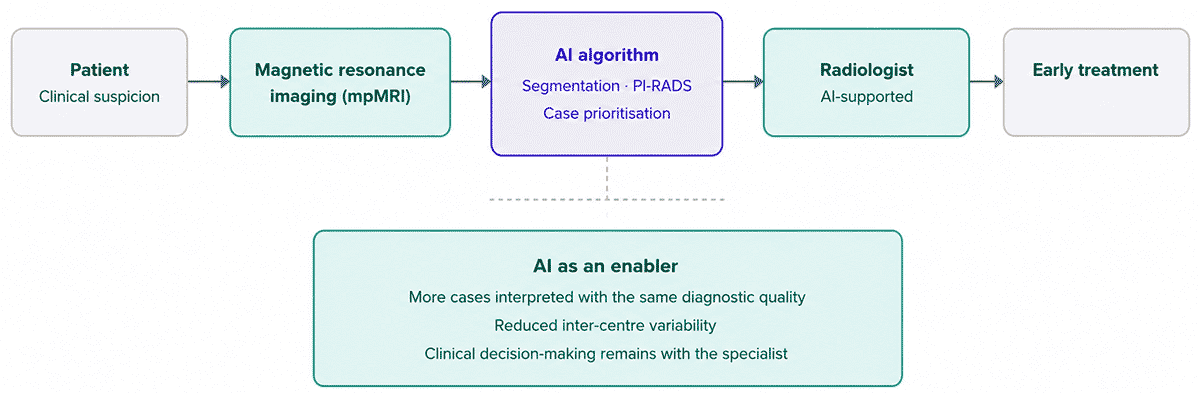 AI-assisted diagnostic workflow.
The result is faster, more efficient care that can support more patients without compromising diagnostic quality. In this process, Artificial Intelligence always acts as a clinical decision support tool, not as a replacement for the healthcare professional.
Its value lies in helping clinicians prioritise, interpret and structure available information more effectively. For patients, this translates into tangible benefits: shorter waiting times, earlier diagnosis and the possibility of avoiding unnecessary invasive procedures.
AI does not replace the specialist: it helps them prioritise, interpret more effectively and reach more patients sooner.
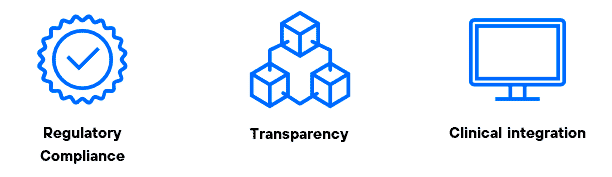
Clinical AI requires safeguards: regulatory compliance, transparency and integration
However, when it comes to tools used in clinical diagnosis, not every AI solution is suitable for clinical use.
The first requirement is regulatory compliance: an algorithm designed to support clinical decision-making must carry CE marking as a medical device. This is not an administrative formality, but a guarantee that the product has been assessed and validated in accordance with regulatory requirements and the safety and performance standards required for use in real-world clinical environments.
Beyond regulation, transparency is a fundamental requirement for the clinical adoption of Artificial Intelligence. Healthcare professionals need to understand the data used to develop and validate an algorithm, the situations in which it performs best and its limitations.
In clinical diagnosis, AI is only useful if it is safe, transparent, regulated and integrated into the clinical workflow.
It is also important that tools allow parameters such as sensitivity and specificity thresholds to be adjusted according to the needs of each organisation, and that they provide clear and understandable information about detected findings. Only then can AI be used as a reliable aid to clinical decision-making, while always maintaining specialist oversight and judgement.
Finally, a clinically effective solution must be able to integrate seamlessly with hospital systems (PACS and RIS) without disrupting or slowing existing workflows.
Our role as a clinical AI technology integrator beyond the algorithm
At Telefónica Tech, we act as a technology integrator, facilitating the deployment of algorithms and the coordination of clinical workflows so that healthcare professionals can focus on patient care. We put technological capabilities at the service of healthcare needs through a vendor-agnostic and deployment-agnostic approach, providing a single integration and management point with services that ensure ongoing operation and maintenance.
We have a broad portfolio of AI-powered diagnostic support algorithms covering multiple clinical conditions, strengthened by specialist providers within our Wayra innovation ecosystem, such as Quibim, a leader in prostate imaging, whose certified solutions are deployed in hospitals across Spain, the United Kingdom, the United States and other countries.
On World Prostate Cancer Day, we want to emphasise that technology only makes sense when it serves people. Not as a substitute for medical expertise, but as what it should be: a tool that enhances the specialist’s ability to detect earlier, treat more effectively and support patients with greater precision.
The value lies not only in the algorithm itself, but in integrating it effectively so that it works in real-world clinical practice.