 Cloud & Business Apps
 Cybersecurity
 Data & AI
 IoT & Connectivity
 Industry
 Health
 Banking and Finance
 Public Sector
 Retail
 Tourism and Leisure
 Transport & Logistics
 Energy & Utilities
 Smart Cities

AI-Native SecOps: framework for assessing the maturity of an AI-enabled SOC
- Introduction
- Why 2026 marks a turning point for AI-Native SecOps
- The volume gap still cannot be closed through hiring
- The 'AI agents for SOCs' category appears to have advanced faster in perception than in real-world deployment
- AI deployment introduces a new risk vector
- Methodology: how the evidence is assessed
- Evaluation framework: seven dimensions of AI-Native SecOps
- Patterns observed in the market
- Data foundation: from claims to a source inventory
- The Assistant → Agent spectrum: from conversation to action
- Agent governance: the widespread blind spot
- Outcome-based measurement: the right metric matters more than the technology
- Over-reliance: the five-person trap
- Honesty about maturity: a strong indicator of reliability
- Commercial model: ROI that does not depend on a future promise
- Evaluation guide for CISOs
- Conclusion
Introduction
AI-native security operations, known in the market as AI-Native SecOps, have become a recurring concept in managed security. According to Gartner, AI agents for SOCs are at the “Peak of Inflated Expectations” in its Hype Cycle for Security Operations, with estimated penetration of just 1-5% of the target market and warnings about the risk of “AI washing”, meaning capabilities being presented as advanced AI when they are not. Forrester, meanwhile, identifies threats associated with AI agents as being among today's leading Cybersecurity risks.
This article does not attempt to settle the semantic debate over what is or is not AI-Native SecOps. Its purpose is more practical: to set out a methodology that CISOs can use to analyse the available market evidence and distinguish between poorly substantiated marketing claims and genuine signs of maturity. Throughout the article, practices observed in the market are cited for illustrative purposes to exemplify each principle, including some of the practices we apply at Telefónica as part of our AI-Native SecOps model.
Why 2026 marks a turning point for AI-Native SecOps
To introduce the concept of AI-Native SecOps, it is worth highlighting three characteristics of the security operations market in 2026:
The volume gap still cannot be closed through hiring
The average SOC may face thousands of incidents every day, with analyst teams under intense operational pressure. At the same time, adversary breakout time has fallen to minutes, with the fastest observed cases measured in seconds. In this context, simply increasing headcount is unlikely to close the gap at the pace required.
The 'AI agents for SOCs' category appears to have advanced faster in perception than in real-world deployment
Gartner moved this category an entire phase (from Innovation Trigger to Peak of Inflated Expectations) in just twelve months, the fastest progression across its entire 2026 Hype Cycle. The report explicitly warns of the risk of AI washing, reinforcing the need to raise the bar in procurement processes for agentic solutions for SOCs.
AI deployment introduces a new risk vector
Forrester documents how AI agents, many of them authorised by the company itself, can act as “shadow operators” when identity, inventory and access to tools are not properly governed. Almost half of the security leaders surveyed by Forrester in 2026 (49%) identify agentic AI itself as a cause for concern.
Any serious assessment of an AI-Native SecOps offering must take these three scenarios into account as essential context.
Methodology: how the evidence is assessed
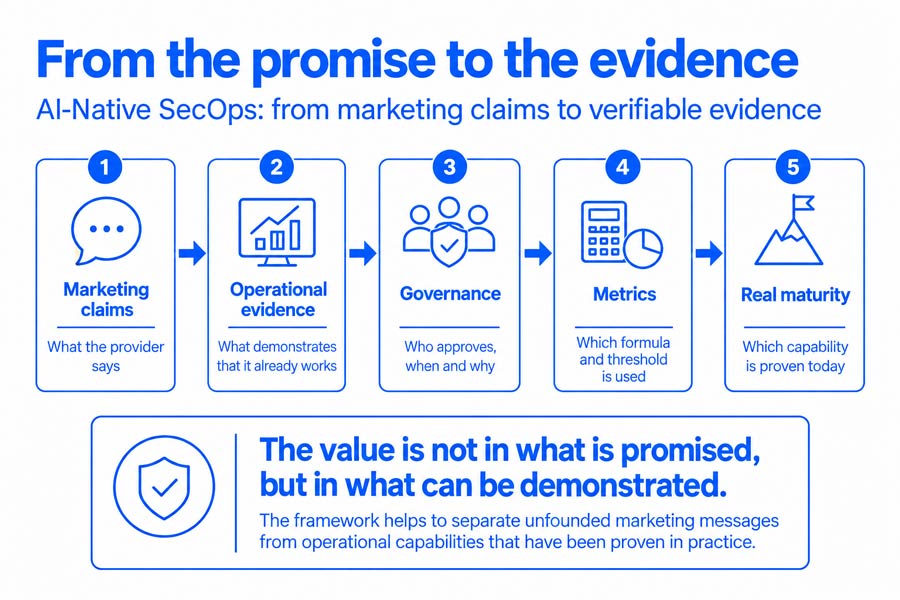
Analyst discipline distinguishes between what a provider says and what it can demonstrate it has built. The process applied in this article, which can be replicated by any security team evaluating providers, follows four steps:
- Triangulation against independent market sources. Every maturity claim is checked against Gartner's most recent Hype Cycle and threat reports from the same period, rather than against the provider's own marketing material.
- Structured document analysis. When a provider supplies architecture documentation, methodology or key performance indicators (KPIs), these are treated as primary evidence: each referenced component (data layers, decision matrices, indicator catalogues) is extracted and compared against what the market standard requires for that same dimension.
- Mapping to a framework of comparable dimensions, so that the assessment does not depend on each provider's own terminology, as different providers often use different names for the same thing, but instead on functionally equivalent capabilities.
- An explicit distinction between what has been demonstrated and what has been promised. A capability is only assessed as mature if the provider supplies operational evidence, such as a KPI formula, a defined threshold or an example workflow with human approval, rather than simply naming the capability.
■ In practice, this process helps to distinguish providers that are better equipped to withstand rigorous procurement scrutiny from those that do not provide sufficient evidence: Gartner predicts that, by 2028, 70% of large SOCs will trial AI agents to support Tier 1 and Tier 2 operations, but only 15% will achieve measurable improvements without structured evaluation. The difference rarely lies in the underlying technology, which is often similar across providers, but in whether the company has subjected its own deployment to the same evidence-based discipline.
Evaluation framework: seven dimensions of AI-Native SecOps
Applying the methodology above to the combined offerings available in today's market reveals seven dimensions for which any AI-Native SecOps offering should be able to provide evidence, rather than simply making claims:
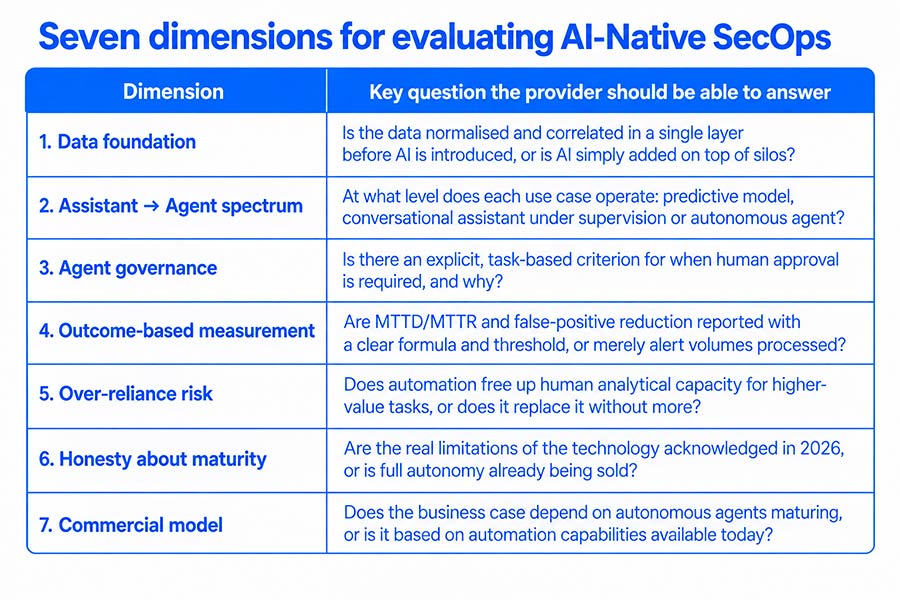
Meeting all seven dimensions is a challenge for any SOC service provider or an organisation's own SOC. The assessment must therefore be honest in determining where coverage gaps exist before an offering can be considered mature.
Patterns observed in the market
Data foundation: from claims to a source inventory
One practice that helps distinguish mature use of AI in the SOC from the superficial addition of conversational capabilities is the ability to demonstrate, in detail, the complete data processing pipeline: collection and normalisation, enrichment and correlation across sources, and structured storage for real-time consumption.
■ At Telefónica, for example, agents operate on a cross-cutting data layer that ingests, processes, normalises and enriches data from the customer's multiple security sources.
The Assistant → Agent spectrum: from conversation to action
Current marketing narratives tend to blur the boundary between the conversational capabilities of a SOC assistant and the capabilities of one or more AI agents that act autonomously under the supervision of human analysts.
■ In Telefónica's AI-Native SecOps model, we use both capabilities. For example, our Cybersecurity developers use a conversational assistant to create a new SIEM detection rule, while an agent handles the CI/CD provisioning workflow in the SIEM.
Another agent in Telefónica's SOC is continuously trained and supervised by our analysts who specialise in threat detection, helping to filter out false positives and prioritise the investigation of true positives.
Agent governance: the widespread blind spot
Agents must be governed by design. Therefore, before they are deployed to production, the first step is to implement a continuous identification process to maintain control over the inventory.
Once inventoried, there must be continuous management of the protection policies that apply to them. In this respect, Identity and Access Management (IAM), Privileged Access Management (PAM) and similar tools should be considered for agents in the same way as for human identities.
■ The AI agents in Telefónica's SOC are represented as service identities to which we apply least-privilege access and authorisation policies by design. They are therefore subject to audit mechanisms comparable to those applied to human identities, adapted to their nature and function.
The next level of maturity that the market may demand from 2027 onwards will be to extend governance across the agent's entire lifecycle. In addition to granting permissions and auditing executed tasks, greater control will be required over the creation, evolution and decommissioning of agents, as well as their impact on the organisation.
Outcome-based measurement: the right metric matters more than the technology
Processing 10,000 alerts a month means nothing if the quality of investigations deteriorates. A sound market practice is to report MTTD, MTTR and false-positive reduction using a defined formula and threshold for each metric, and to separate types of impact (operational efficiency, SLA compliance and improved resilience) rather than combining them into a single “productivity” figure.
The challenge for a CISO is to start with a holistic view of all strategic, tactical and operational KPIs, taking into account the variety of data sources from which those KPIs are derived.
Only with this visibility into the state of the SOC is it possible to assess the financial, operational and workforce impact of introducing AI agents into its day-to-day management.
■ At Telefónica, our CISO Control Tower service is designed to address this challenge.
Over-reliance: the five-person trap
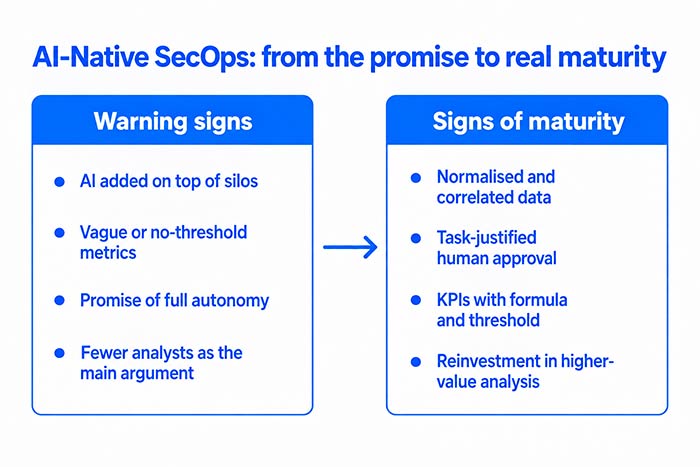
Gartner's projection that 75% of SOCs will experience erosion of fundamental analytical skills by 2030 due to over-reliance on AI makes any sales proposition centred on “fewer analysts” a warning sign.
At Telefónica, we distance ourselves from the sales slogan “run your SOC 24x7 with just 5 analysts” and advocate reinvesting the efficiencies generated by automation and AI in higher-value analytical activities such as proactive threat hunting (threat hunting) and threat intelligence (threat intelligence).
Honesty about maturity: a strong indicator of reliability
It is essential for commercial messaging to include realistic indicators that enable the maturity of agentic capabilities within an AI-Native SecOps offering to be assessed reliably. Communicating error rates, operational limitations and return metrics using transparent criteria provides a counterweight to inflated expectations and builds greater confidence when deploying or procuring security operations supported by AI agents.
Commercial model: ROI that does not depend on a future promise
A more defensible market approach is a business case built on automation that is already available: SOAR, the progressive reduction of Tier 1 tasks, reinvestment of efficiencies, or comprehensive end-to-end visibility of the security posture.
In the context of a SOC that already has a high degree of automation, generative AI and agents act as incremental accelerators, rather than as a prerequisite for success.
A customer's assessment of a SOC's agentic capabilities should begin by asking about the automation already deployed. This helps reduce the risk of purchasing an AI-Native SecOps offering that depends more on a future promise of autonomy than on operational capabilities that can already be demonstrated.
Evaluation guide for CISOs
A buyer can apply the same four-step process described in the Methodology section to any provider, demanding evidence rather than claims on each of the following points:
- Ask for the complete data architecture diagram, not just the name of the data lake.
- For every use case described as “AI”, ask the provider to specify whether it uses machine learning, a conversational assistant or an agent, and how long it has been in production.
- Ask for the explicit, rather than generic, criteria that determine when an automated action requires human approval.
- Ask for the formula and threshold for every KPI reported, not just the name of the metric.
- Ask directly how efficiencies from automation are reinvested, and be wary of any answer focused solely on reducing workforce costs.
- Ask what percentage of the provider's AI use cases are, by its own assessment, below full maturity.
- Require the business case to stand up on the technology available today, rather than on a projection of future autonomy.
Conclusion
The AI-Native SecOps market is currently at the point where the gap between expectations and reality is at its widest, according to industry analysts themselves. A more rigorous way to approach this situation is neither to accept nor reject the AI-Native SecOps label, but to break it down into the seven evidence dimensions described in this article and require each provider to substantiate them with verifiable data.
SOC providers that combine an auditable data architecture, an explicit framework for task-level risk decisions, a KPI catalogue with defined formulas and thresholds, and honest communication about the real limitations of AI will not necessarily have achieved full maturity in AI-Native SecOps, a category that is still taking shape. But they may be better positioned to sustain that transition without exposing customers to the expectations reset that the industry itself anticipates over the coming months.
______