 Cloud & Business Apps
 Cybersecurity
 Data & AI
 IoT & Connectivity
 Industry
 Health
 Banking and Finance
 Public Sector
 Retail
 Tourism and Leisure
 Transport & Logistics
 Energy & Utilities
 Smart Cities

IoT Asset Control for more efficient energy asset management
The digitalisation of energy assets: an increasingly critical challenge
The energy sector is undergoing significant transformation. The growing complexity of power networks, the geographical spread of installations and the need to ensure service continuity mean organisations need complete visibility across their assets.
Electrical switchboards, substations, lighting systems, backup equipment, fuel storage tanks and renewable energy installations are often distributed across multiple locations and, in many cases, operate without real-time monitoring capabilities.
This lack of visibility can result in unexpected failures, increased operating costs, unnecessary site visits and reduced service quality. The good news is that the combination of IoT and data analytics is enabling organisations to build smarter energy infrastructures that are more connected and remotely manageable.
Without visibility, failures, costs and operational risk increase.
The challenges of traditional energy infrastructure management
Many organisations still rely on periodic inspections, manual checks or disconnected systems to monitor their assets. This creates a significant gap between the moment an issue occurs and the moment it is detected.
The main challenges include:
- Limited visibility of the actual condition of installations.
- Late detection of faults and electrical anomalies.
- Higher costs associated with corrective maintenance.
- Unnecessary site visits for inspection and diagnostic activities.
- Service disruption risks caused by undetected failures.
- Difficulty optimising energy consumption and equipment performance.
■ In an environment where availability and efficiency are critical, access to real-time information becomes a clear competitive advantage.
Real-time information enables organisations to anticipate issues rather than simply react to them.
Asset Control: remote monitoring and management of energy assets
Asset Control is our IoT solution designed to connect and monitor distributed assets through smart devices, IoT connectivity and a centralised management platform.
The solution enables organisations to capture operational data in real time and transform it into actionable insights that help optimise the performance of energy installations.
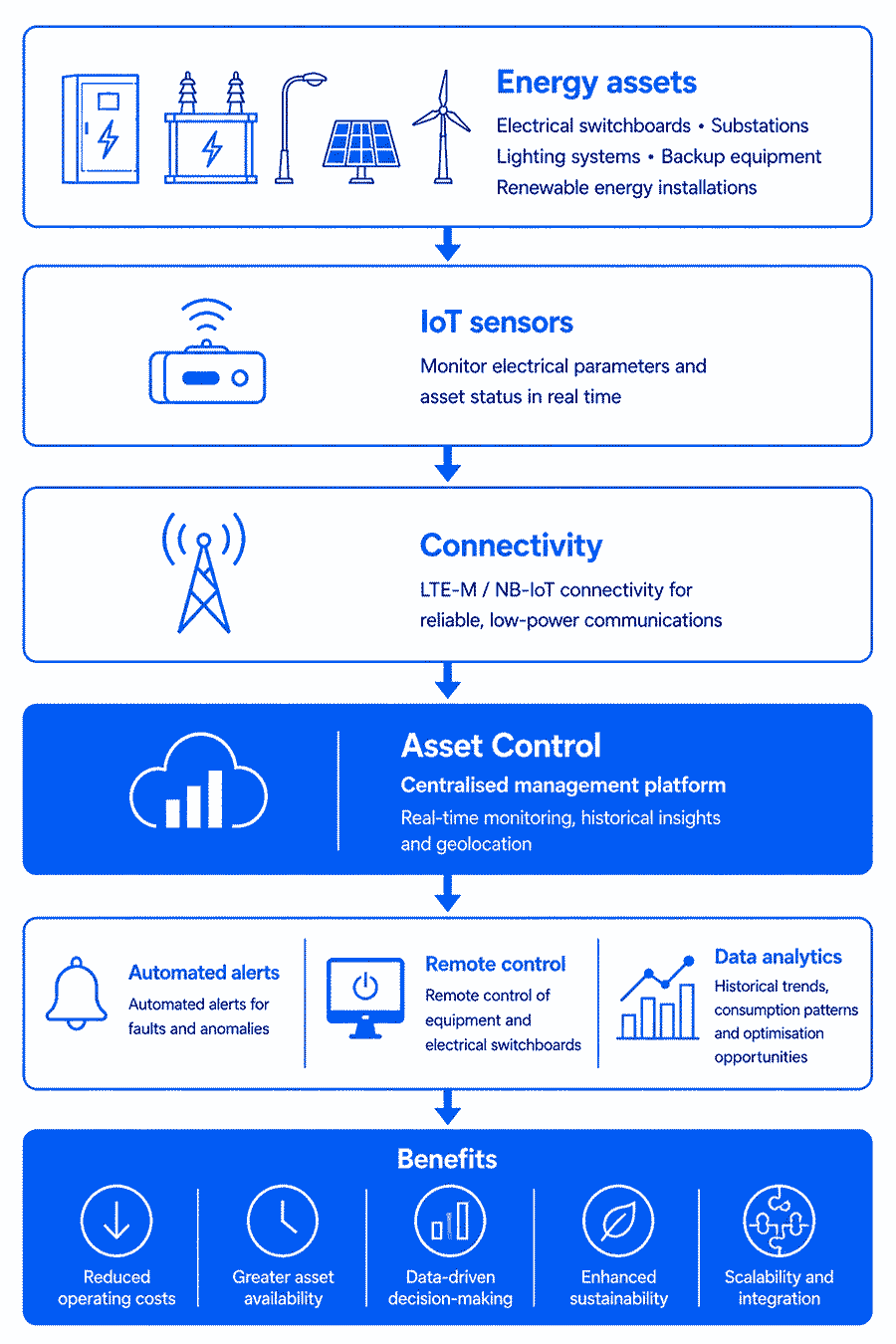
With Asset Control, organisations can:
- Monitor electrical parameters such as voltage, current, energy consumption and power quality.
- Detect voltage spikes, voltage drops and abnormal operating behaviour before they lead to incidents.
- Configure automated alerts whenever predefined thresholds are exceeded.
- Remotely control the switching on and off of selected equipment or electrical switchboards.
- Analyse historical trends to identify consumption patterns and optimisation opportunities.
- Track distributed assets using geolocation technologies.
- Integrate data with enterprise systems through APIs.
Asset Control transforms operational data into actionable decisions.
Energy sector use case: smart electrical switchboards
One of the most common scenarios for energy companies, local authorities and service providers is the management of electrical switchboards distributed across multiple locations.
Traditionally, fault detection relies on periodic inspections or incidents reported by end users. As a result, response times are often longer than desired and failures can have a significant impact on service quality.
With Asset Control, organisations can continuously monitor parameters such as:
- Electrical current.
- Voltage.
- Energy consumption.
- Operational status of the installation.
- The platform automatically generates alerts when anomalies are detected, including:
- Overloads.
- Short circuits.
- Voltage drops.
- Component failures.
- Failure to comply with scheduled switching programmes.
■ This enables immediate action to be taken and reduces the risk of an incident having a significant impact on operations.
Real-world case: monitoring decorative lighting installations
A decorative lighting company needed to improve fault detection in the field, maintain service levels and optimise operating costs.
To achieve this, it deployed an IoT-based solution capable of monitoring parameters such as current, voltage and energy consumption in the electrical switchboards powering its lighting installations.
The devices, connected via LTE-M and NB-IoT technologies, transmitted information in real time to the Asset Control platform, where automatic alerts were generated whenever anomalies were detected.

Key improvements observed
- Immediate detection of overload events.
- Early identification of short circuits and component failures.
- Verification of the correct operation of switching schedules.
- Improved service levels.
- Reduced incident response times.
Benefits of IoT monitoring in the energy sector
Implementing IoT solutions for asset management delivers direct benefits at both operational and strategic levels:
- Reduced operating costs
Early incident detection and data-driven maintenance help reduce site visits, minimise failures and optimise resources. - Greater asset availability
Continuous monitoring helps prevent unexpected interruptions and improve service continuity. - Data-driven decision-making
Access to historical and real-time information makes it easier to identify patterns and opportunities for improvement. - Enhanced sustainability
Optimising energy consumption and extending asset lifecycles help reduce environmental impact. - Scalability and integration
The open architecture of Asset Control makes it easy to integrate information with enterprise platforms and scale the solution as business requirements evolve.
Monitoring assets with IoT helps organisations operate more efficiently and sustainably.
The future of energy management is connected
The digitalisation of energy infrastructure is no longer a future trend but a necessity for improving efficiency, increasing availability and advancing sustainability.
With Asset Control, organisations can transform traditional assets into intelligent infrastructures capable of providing real-time information, anticipating incidents and optimising operations from a single platform.
The result is more efficient management, higher service quality and a stronger capability to address the challenges of an increasingly connected and demanding energy sector.
Better energy management starts with connected assets.