 Cloud & Business Apps
 Cybersecurity
 Data & AI
 IoT & Connectivity
 Industry
 Health
 Banking and Finance
 Public Sector
 Retail
 Tourism and Leisure
 Transport & Logistics
 Energy & Utilities
 Smart Cities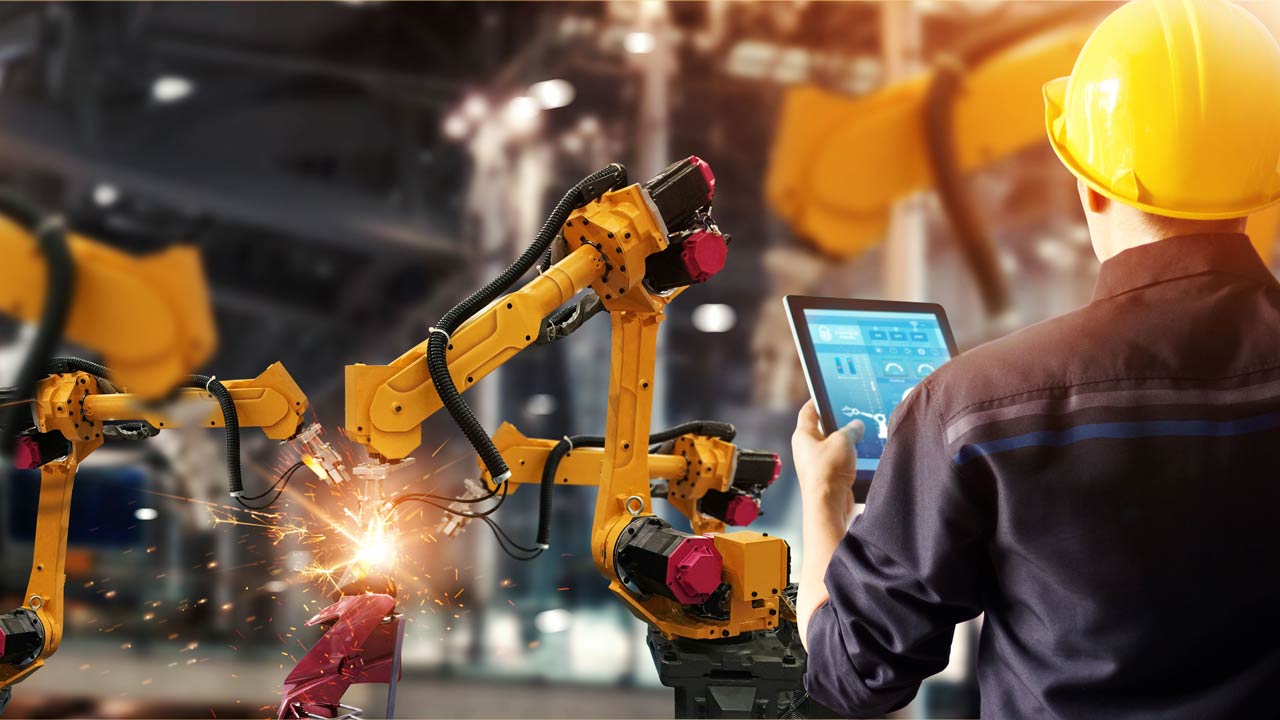

AI applications in industry: driving operational transformation
Artificial Intelligence is changing the way industrial companies manage their operations. It is no longer limited to analysing data: today, it supports operational decision-making and enables automated responses within production processes, delivering useful information where it is generated and when it is needed.
The combination of sensors, connectivity, advanced analytics and AI models helps manufacturers anticipate issues, optimise resources and make decisions with greater insight and agility.
This evolution forms part of the ongoing development of Industry 4.0 and cyber-physical systems, in which machines, sensors and digital platforms continuously exchange information to improve efficiency, quality and operational resilience.
However, for these capabilities to deliver tangible value, they must be integrated into industrial strategy, existing systems and the frameworks governing security, data governance and operational oversight.
In this way, AI is becoming established as a cross-functional technology, with applications ranging from predictive maintenance and process optimisation to on-site inference and industrial Cybersecurity.
Distributed AI brings decision-making closer to where and when industrial processes take place.
Anticipating issues to prevent unplanned downtime
Predictive maintenance is one of the areas in which Artificial Intelligence is being applied most effectively. Using information captured by sensors deployed across equipment and facilities, AI models can detect operating patterns, identify anomalies and anticipate when the likelihood of a failure that could cause disruption is increasing.
This approach makes it possible to move away from scheduled inspections or reactive interventions towards an asset maintenance strategy based on actual condition. As a result, companies can reduce downtime, plan interventions more effectively and extend the service life of machinery and infrastructure.
—Example: when monitoring the condition of industrial sensors, AI can help predict battery depletion or detect deviations in readings that could compromise data reliability. This can reduce unnecessary interventions and help maintain more reliable operational information.
Greater asset availability, fewer production disruptions and more efficient use of resources.
Bringing intelligence to the production floor
AI in industry is not simply about sending data to a centralised platform for analysis. Increasingly, organisations are choosing to run models directly on the production floor, close to the equipment, production lines and sensors that generate the information.
This approach, known as on-site inference, enables responses with lower latency and reduces dependence on communications with remote data centres. In this way, AI can identify anomalies, recommend operational adjustments or trigger automated actions according to predefined rules, helping to improve operational efficiency and shorten response times.
At the same time, the shift towards physical AI is expanding the role of Artificial Intelligence in industrial environments. By combining sensors, connected devices, robotics and intelligent models, cyber-physical systems can interpret what is happening around them, interact with their environment and respond in a coordinated way to changes in production.
Faster decisions, more efficient processes and a greater ability to adapt to changes in production.
Optimising processes to improve efficiency and competitiveness
AI is also changing the way companies optimise their production processes. By continuously analysing the performance of machinery, production lines and industrial systems, it is possible to identify opportunities for improvement that would be difficult to detect using traditional methods.
Combining data from multiple sources makes it possible to turn operational information into actionable insight that can be used to adjust operating parameters, reduce deviations and optimise variables such as energy consumption, equipment performance and final product quality. This ability to adapt continuously helps keep processes within their optimal operating range, even when production conditions change.
Beyond automating specific tasks, AI helps create more flexible operations that can respond quickly to new demand, variations in production and changes in the operating environment. This continuous improvement helps increase productivity and make better use of available raw materials and resources.
More efficient processes, higher production quality and smarter use of available resources.
Protecting an increasingly connected and intelligent industrial environment
The digitalisation of industrial environments and the adoption of Artificial Intelligence also make it necessary to provide stronger protection for increasingly interconnected systems that are critical to business continuity.
In this context, industrial OT Cybersecurity is essential to protect production infrastructure against threats that could compromise both operational availability and the safety of people and equipment. AI supports the detection of anomalous behaviour, helps identify potential risks and can accelerate incident response.
This approach becomes even more relevant in cyber-physical systems, where sensors, machines, networks and digital platforms exchange information and operate in a coordinated way. Strengthening the security and resilience of this ecosystem is essential to move towards more reliable and flexible operations that are better prepared for emerging challenges.
An intelligent industrial environment must also be secure, resilient and better prepared to respond to incidents.
Conclusion
The value of AI in industry lies in its practical application across operations. It spans the entire operational lifecycle: from anticipating failures and continuously optimising processes to bringing decision-making closer to the point of operation and protecting industrial environments.
Rather than being a standalone technology, AI acts as an enabler of digital transformation. When integrated with sensors, cyber-physical systems and management platforms, it helps manufacturers improve their competitiveness through digital solutions that are more secure, scalable and intelligent. The result is an industry with a greater capacity to adapt, better prepared to address current challenges and identify new opportunities.
Artificial Intelligence is driving a more efficient, connected, resilient and competitive industry.