 Cloud & Business Apps
 Cybersecurity
 Data & AI
 IoT & Connectivity
 Industry
 Health
 Banking and Finance
 Public Sector
 Retail
 Tourism and Leisure
 Transport & Logistics
 Energy & Utilities
 Smart Cities


Black Friday in-store: improving the shopping experience with technology to manage prices and promotions
In a store, during a campaign such as Black Friday, retailers may need to take into account products selling out, offers going live at a specific time or lasting just a few hours, and prices that need to be adjusted at different points in the campaign.
That is why the challenge for the business is to keep information up to date as these changes take place, sometimes simultaneously. Otherwise, an outdated promotion may continue advertising an out-of-stock item, or a shelf-edge label may show a different price from the one charged at the till.
Retailers can use two technologies with different functions to address this: digital displays, which make it possible to manage promotional content across the store, and electronic shelf labels, which make it possible to manage the prices and information displayed next to products at the shelf edge.
Using both technologies can contribute to a better shopping experience for customers and better business processes by keeping customer-facing retail information up to date and improving sales operations.
■ When implementing them, it is important to distinguish scheduled changes from updates driven by price or stock data and to understand how these technologies connect to management and inventory systems.
Digital displays: communicating offers and tailoring them to each store
Today, customers may learn about an offer before arriving at the store and compare prices on their phone while shopping. For the retailer, the question is what to show them in each area of the store and how to adapt messages to the promotions currently running.
Scheduling content by location, time and campaign
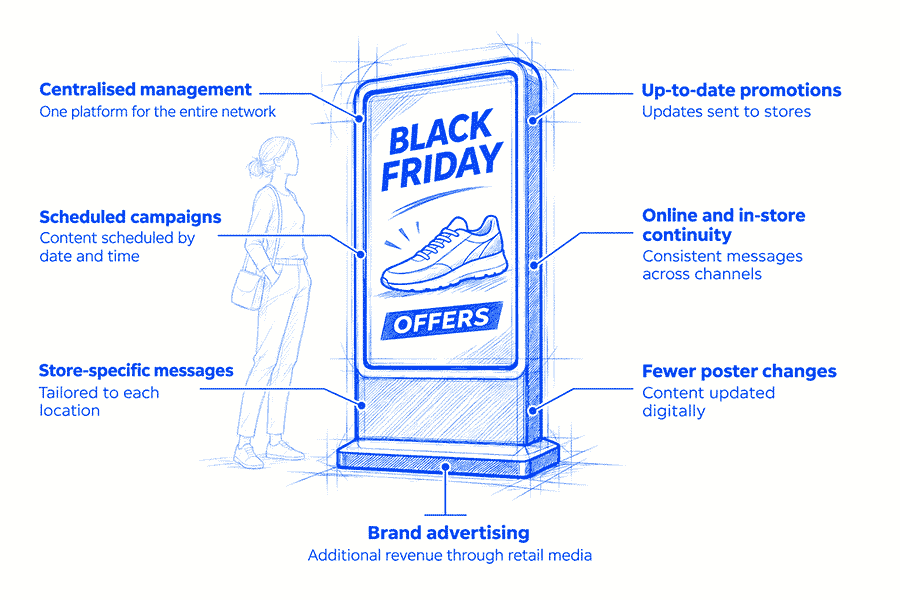
Digital signage makes it possible to schedule which content appears on each screen according to location, time of day or the campaign currently running. This allows retailers to adapt messages without having to replace signage for every promotion. When that adaptation depends on audience or inventory data, data sources and integrations are needed to provide that information.
Updating messages during the campaign
For a retail chain with dozens or hundreds of locations, managing promotional messages can become complex. During Black Friday, for example, products may sell out within hours, new limited-time promotions may go live, or prices and stock levels may vary from one store to another.
Updating every screen manually makes it difficult to keep all messages current. A centralised digital signage platform makes it possible to push changes to the relevant stores.
In addition, if the platform receives up-to-date stock data and is configured accordingly, it can, for example, remove a promotion for a product that has sold out.
Maintaining continuity in-store for offers seen online
A customer may also discover a promotion online or receive a personalised offer by email, then look up information about the product on their phone before going to a physical store to complete the purchase. Once they are in front of the product, the shopper has reached the 'last metre' of that journey: the point at which they can compare the offer with what they actually find in the store.
At this stage of the journey, digital displays can reinforce a promotion the customer already knows about, highlight other products or help them locate the area of the store where the offer can be found. To maintain continuity throughout the purchase journey, in-store messages need to be consistent with what has been advertised through other channels.
An offer that a customer discovers online needs to remain consistent when they reach the store.
Choosing which promotions to show in each store and at different times
Even within the same retail chain, promotions may vary depending on the location of each store. A city-centre store may need different offers from one in a shopping centre. Promotions may also vary from one region to another.
The differences are not limited to location: the same store may also change its content between the morning and afternoon. From a commercial perspective, the key is to choose which offers are relevant to the people shopping in each store at each particular time.
Digital signage platforms make it possible to schedule these campaign variations by store and time, without requiring the entire network to display the same messages at the same time.
The Brain: centralised screen management
Our The Brain platform brings together different solutions for digitising physical spaces. For digital signage, it provides capabilities to manage a network of screens and tailor their content schedules. During a campaign such as Black Friday, it makes it possible to:
- Manage a network of screens from a centralised platform.
- Distribute content automatically.
- Adapt content by location or store type.
- Schedule campaigns.
- Update messages.
- Coordinate content rollout with other commercial activities.
To prepare a campaign using these capabilities, the commercial team needs to define which content should appear in each store, when it should go live and which changes will be scheduled in advance. If an update depends on inventory, the team also needs to check which data the platform receives and how it is used.
Alongside the messages shown on screens, customers need to be able to check the price and, where that data is available, availability next to the product. Electronic shelf labels make it possible to update this information directly at the shelf edge.
■ Retailers can also offer brands advertising space on their in-store screens alongside their own promotions. This use of in-store screens, known as in-store retail media, can generate additional revenue by displaying advertising close to the point of purchase.
Electronic shelf labels: prices, promotions and availability at the shelf edge
In a store using paper labels, preparing for Black Friday may involve hundreds of manual price changes and many hours of work, with the risk of errors. A last-minute change means going back to the shelves and manually replacing the affected labels.
For a retail chain carrying hundreds or thousands of SKUs, this work is compounded by the difficulty of maintaining the correct price for each channel and store according to the promotion currently running. In addition, in-store prices may differ from those on the online platform.
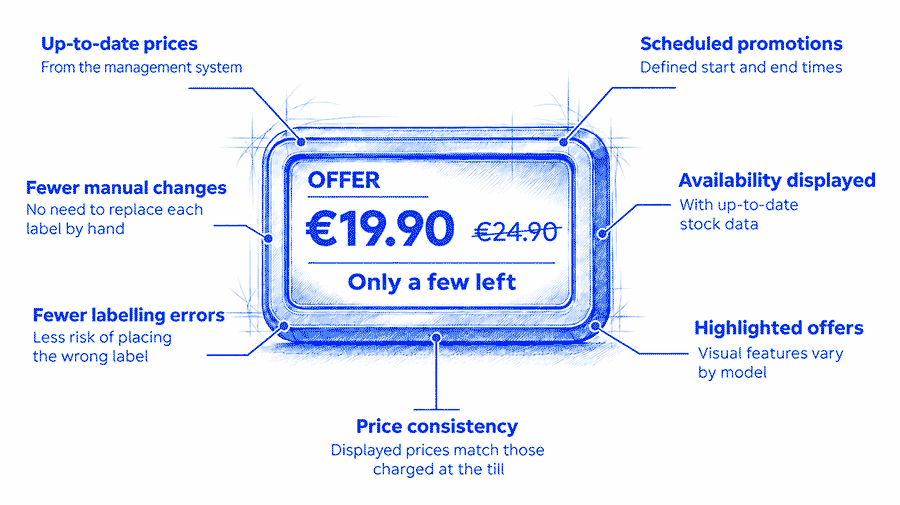
E-paper labels make it possible to update shelf-edge prices from a centralised platform. To display the correct price for each store and maintain consistency with the price charged at the till, they need to be connected to the systems that manage those prices.
ERP integration: automating price changes
When the label platform is connected to the ERP (enterprise resource planning system) or other management systems, price changes recorded in those systems can be reflected automatically on the shelf labels, without labels having to be replaced manually. This connection makes it possible to:
- Push price changes recorded in the management system to the labels.
- Reduce errors associated with changing labels manually.
- Maintain consistency between the displayed price and the price charged at the till.
- Reduce the time spent on these tasks.
- Update shelf-edge prices to reflect the price adjustments the retailer decides to make in response to demand or changes in stock.
Connected to management systems, electronic shelf labels make it possible to update prices without changing each label by hand.
Scheduling promotions in advance
As well as applying changes recorded in management systems, the label platform makes it possible to schedule prices and promotional messages days or weeks before Black Friday so that they appear at the planned time. For example:
- Activate discounts at 00:00 on Black Friday.
- Run flash promotions during specific time slots.
- Launch specific promotions for particular products.
- Restore the price and remove the promotional message at the scheduled time.
—The examples above are based on schedules and conditions defined in advance, but the same approach also applies when conditions change. For example, if stock levels change during the campaign and an offer needs to be adjusted, the platform can use the latest inventory information and apply the rules defined in the management systems, provided that it is integrated with those systems and configured to do so.
Reflecting price changes based on stock levels
As a result, retailers can use stock levels as a criterion for adjusting prices and define the corresponding rules in their management systems. When connected to those systems, the labels display the changes decided by the retailer. For example:
- Clearing excess stock: if stock of a product builds up or the product has a slower rate of sale, the retailer can schedule discounts in the management system to help sell it through and free up space.
- Reflecting price adjustments for high-demand products: if an item is in high demand and stock is limited, the retailer can review its price and apply the chosen adjustment to the label through the management system.
- Adjusting discounts on perishable products: if units remain at the end of the day and need to be sold within a short period, the retailer can apply a reduction in the management system and reflect it on the labels.
Showing availability next to the product
For shoppers, finding an attractive promotion and then discovering that the item is out of stock can be frustrating. When electronic shelf labels receive up-to-date stock data, they can show availability through messages such as 'Out of stock' or 'Only a few left'. They can also display messages such as 'More stock expected soon' or 'Available online', provided, respectively, that they have information on expected replenishment or stock levels in the online channel.
By displaying this information at the shelf edge, labels allow shoppers to check availability without having to ask store staff each time, which can help maintain purchase intent or allow the purchase to continue through another channel. For the store team, identifying out-of-stock SKUs also helps to prioritise replenishment.
Making offers and products more visible at the shelf edge
As well as providing information on availability, electronic shelf labels can highlight offers and products using colours, icons, indicator lights or graphical elements, depending on the model.
During Black Friday, retailers can use these features to highlight products with the biggest discounts, new products, exclusive products or flash promotions. They can also give greater visibility to high-margin products, even though that commercial criterion is not communicated to the shopper.
This means that shoppers can identify the offers the retailer has chosen to highlight directly next to the product, together with the reduced price and the previous price.
Adapting a promotion when a product sells out requires stock information as well as scheduling the offer.
What information each in-store format needs
When preparing the campaign, it is important to assign each format a specific role: which promotions the screens will display and which prices or messages the labels will show.
For each update, it is important to identify where the information comes from, when it needs to go live and which inventory changes may require it to be updated.
It is also necessary to define which actions the system will carry out and which will be handled by the team. This defines the scope of automation before it is implemented, both for scheduled changes and for those driven by stock levels.
Conclusion
For customers, having information about availability can reduce the frustration of finding that a product on promotion is out of stock and make it easier to decide how to continue with the purchase: wait for it to be restocked or use the online store if stock is available through that channel.
For retailers, these alternatives can help avoid losing sales opportunities when a product sells out in-store. In day-to-day operations, centralised management of screens and labels makes it possible to update promotions and prices with less manual work while reducing the errors associated with those changes. To achieve this, the platforms need to be connected to the relevant systems and configured to carry out those updates.
■ At Telefónica, we help retailers connect channels and automate processes to improve operations and the shopping experience. Our Retail solutions portfolio allows businesses to explore how to address these needs based on their systems and priorities.
AUTHORS
Mariano Banzo Martínez
Retail Product Manager
David Crespo Núñez
Retail Product Manager
______
.jpg "Smart shelving does not only store products, but also knowledge and efficiency")