 Cloud & Business Apps
 Cybersecurity
 Data & AI
 IoT & Connectivity
 Industry
 Health
 Banking and Finance
 Public Sector
 Retail
 Tourism and Leisure
 Transport & Logistics
 Energy & Utilities
 Smart Cities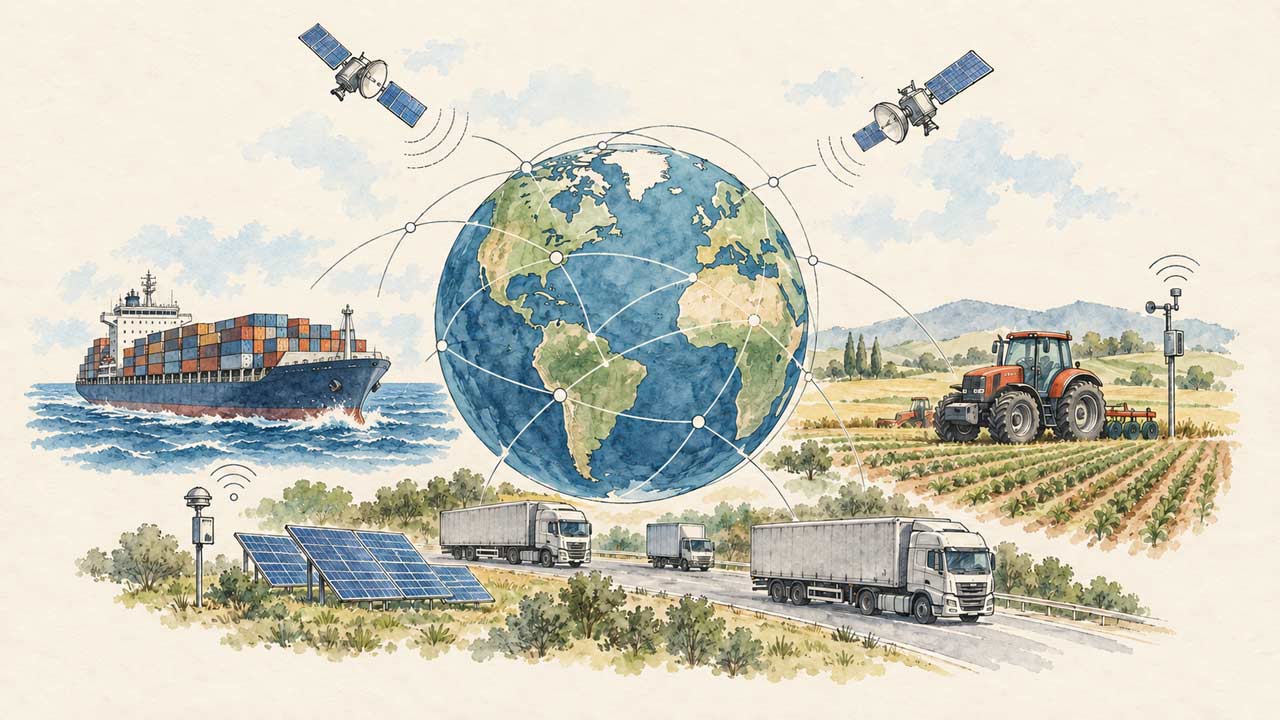

Expanding the boundaries of IoT: SGP.32 eSIM, satellite connectivity and AI for more global, flexible and intelligent connectivity
In previous articles, we have explored how managed IoT connectivity has become a key enabler of digital transformation for businesses and how advanced platforms such as Kite Platform make it possible to manage, automate and optimise millions of connected devices.
But the evolution of IoT does not stop there.
Emerging technologies are expanding the boundaries of IoT connectivity and making it possible to address challenges that until recently seemed out of reach: connecting devices virtually anywhere in the world, simplifying global deployments, reducing dependence on local infrastructure and managing connectivity with unprecedented levels of flexibility.
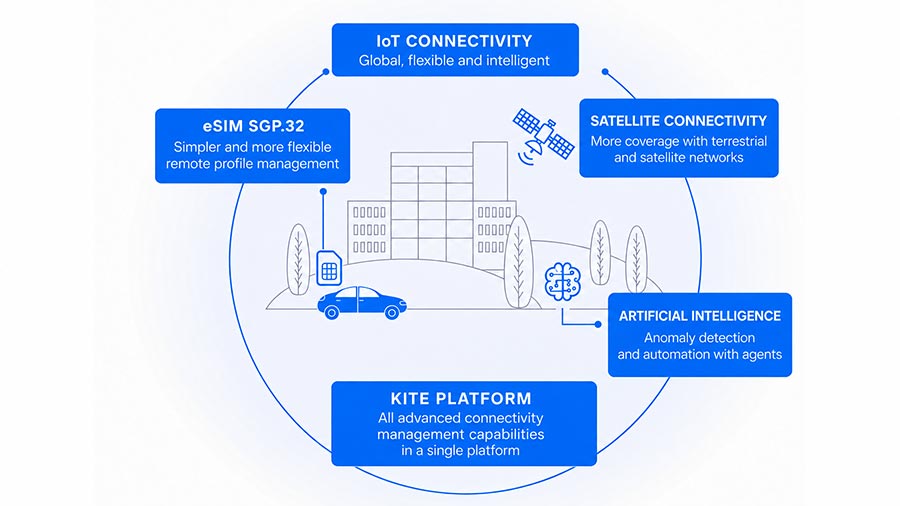
In this new landscape, innovations such as the SGP.32 eSIM standard, the integration of satellite networks and new capabilities powered by Artificial Intelligence are redefining the future of IoT and accelerating the adoption of increasingly ambitious use cases.
■ The next IoT revolution will not be defined by the number of connected devices, but by the ability to connect them globally, manage them intelligently and adapt dynamically to different scenarios, while turning every connection into a source of business value.
The next generation of eSIM: simpler, more flexible and designed for IoT
eSIM technology has been transforming the way businesses manage connectivity for their devices for years. However, traditional models have presented certain limitations for large-scale, global IoT deployments, particularly when organisations need to switch operators or manage devices distributed across multiple countries.
The arrival of the new SGP.32 standard represents a significant step forward for the IoT ecosystem.
This new generation of eSIM has been designed specifically to meet the needs of the Internet of Things, simplifying the remote management of connectivity profiles and enabling greater interoperability between operators. It also allows multiple profiles to be stored on the same eSIM and switched remotely, securely and efficiently.
What does this mean for businesses?
- Greater flexibility to deploy devices in any market.
- Less dependence on a specific operator.
- Simpler international deployments.
- Lower operational and logistics costs.
- Faster adaptation to regulatory or coverage changes.
Thanks to these capabilities, connectivity is no longer a fixed decision made when a device is manufactured and instead becomes a dynamic resource that can evolve throughout its lifecycle.
With SGP.32, IoT connectivity is no longer tied to the initial operator and can instead be managed remotely, flexibly and securely throughout the device lifecycle.
Satellite connectivity: taking IoT where it could not reach before
Although terrestrial mobile networks remain the foundation of most IoT deployments, there are many remote environments where terrestrial coverage is unavailable.
Remote energy facilities, critical infrastructure, assets in transit, vessels, agricultural operations and environmental projects are just some examples.
The integration of satellite connectivity into the IoT ecosystem is helping to overcome these limitations.
Today, it is possible to complement terrestrial mobile networks with satellite networks that provide coverage in virtually any location, delivering greater resilience and service continuity.
This opens the door to new use cases such as:
- Monitoring infrastructure in remote locations.
- Global tracking of assets and goods.
- Real-time environmental monitoring.
- Smart agriculture in rural areas.
- Critical services where availability is essential.
■ The combination of mobile and satellite connectivity enables organisations to design more robust solutions capable of delivering greater operational continuity, regardless of where their devices are located.
Satellite connectivity extends IoT to environments without terrestrial coverage and strengthens operational continuity wherever availability is critical.
Artificial Intelligence: from intelligent connectivity to agent-based automation
AI is becoming another major driver of IoT innovation.
Traditionally, the goal was to understand and monitor what was happening on the network and anticipate what might happen next. Today, AI makes it possible to analyse the behaviour of millions of connections in real time to identify patterns, detect anomalies, optimise resources and even automate processes.
In practice, this means the platform can:
- Detect unusual usage patterns to prevent unexpected costs.
- Identify potential fraud or security incidents.
- Anticipate operational failures.
- Automate corrective actions.
- Continuously optimise connectivity usage.
In addition, the emergence of AI agents specialised in IoT is opening up new possibilities for simplifying day-to-day operations. These agents can analyse information from thousands of devices, generate recommendations and help automate processes, notifications and operational tasks, allowing organisations to focus on higher-value activities.
Connectivity is therefore evolving from a reactive model towards intelligent connectivity capable of monitoring, anticipating and taking action to optimise business operations.
AI turns IoT connectivity into an intelligent capability that can detect, anticipate and take automated action to optimise business operations.
Towards truly global IoT
The combination of SGP.32 eSIM, satellite connectivity and AI is laying the foundations for a new generation of IoT solutions.
A model in which virtually any device can connect from almost anywhere, dynamically adapt to different networks, automate its management and generate actionable insights to support decision-making.
In this context, connectivity management platforms are becoming even more important, as they are responsible for orchestrating all these capabilities and turning connectivity into a competitive advantage for businesses.
■ Just as managed connectivity enabled businesses to move from simply connecting devices to managing them efficiently, these new innovations will enable organisations to operate with greater flexibility, resilience and intelligence.
Global IoT is built by combining flexible connectivity, extended coverage and operational intelligence within a single managed architecture.
Kite Platform: ready for the next generation of IoT connectivity
At Telefónica, we continue to drive this evolution by continuously incorporating these new capabilities into our managed IoT connectivity platform, Kite.
Kite Platform has evolved to address the emerging challenges of IoT, bringing together advanced connectivity management, SGP.32 eSIM orchestration, Artificial Intelligence and future hybrid terrestrial-satellite connectivity options within a single solution, enabling businesses to make the most of the new technologies that are redefining the market.
In this way, technologies such as the SGP.32 eSIM standard, satellite connectivity and AI agents are no longer isolated innovations, but become capabilities accessible through Kite, a single, centralised and scalable platform designed to support global operations.
Beyond connectivity management, Kite is evolving towards a model that helps customers simplify their operations, automate processes and extract greater value from the data generated by their connected devices. Kite Platform not only makes it possible to monitor and anticipate events, but also to trigger intelligent actions that optimise business operations.
The goal is simple: to help our customers deploy global IoT solutions with greater agility, flexibility and efficiency, regardless of the country, network or technology involved.
Because the future of IoT is no longer simply about connecting things. It is about creating intelligent ecosystems capable of connecting from anywhere, dynamically adapting to new requirements, automating operations and continuously generating value.
Kite Platform brings together the latest IoT capabilities to help businesses deploy, automate and operate connected solutions at global scale.