 Cloud & Business Apps
 Cybersecurity
 Data & AI
 IoT & Connectivity
 Industry
 Health
 Banking and Finance
 Public Sector
 Retail
 Tourism and Leisure
 Transport & Logistics
 Energy & Utilities
 Smart Cities

Human and non human identity in the age of AI: how to govern digital trust
In an context where Artificial Intelligence operates with increasing autonomy, trust becomes the critical asset. That was the starting point of the keynote delivered by David Prieto, Head of Identity, Data & AI Security at Telefónica Tech, at MWC 2026. During the session Human and non-human identity in the age of AI, he distilled the challenge into a key idea: “There is no trustworthy AI without a trustworthy identity.”
Because, as he explained, identity is no longer just authentication: it is the control plane of digital trust.
Governing AI: decision, accountability and identity
AI is no longer a promise. It decides, acts and executes processes at high speed and with growing autonomy. But every action has consequences.
“We must know who does what, how and why,” David explained. When an automated decision impacts a customer, infrastructure or critical service, traceability is no longer optional. During his speech, he structured this challenge across three interrelated layers:
- The decision, where AI acts autonomously.
- Accountability, which demands clarity about consequences.
- Identity, which connects and enables governance across both dimensions.
The conclusion was clear: “There is no governable AI without governable identity.” If the message had to be condensed into three words, they would be: Artificial Intelligence. Trust. Identity.
And under this triad, a fourth essential element: cryptography. If cryptography is weakened, especially in a quantum computing scenario, identity is weakened as well. And without a strong identity, trust breaks down.
In the age of AI agents, identity governs digital trust under sovereign, traceable and scalable policies.
Identity as a social, economic and systemic driver
Beyond technology, the keynote focused on the structural impact of digital identity.
David reminded the audience that, at the social level, hundreds of millions of people worldwide lack a legal or digital identity. “We are not just talking about authentication; we are talking about inclusion,” he noted. Without identity there is no access to services, nor participation in the digital economy. Mobile identity is an essential tool to close that gap, driven by initiatives such as those we are promoting together with the GSMA.
At the economic level, identity acts as a catalyst. It reduces friction, limits fraud and improves the user experience while enabling new business models. Initiatives such as eIDAS 2.0 and the European digital wallets will transform the interaction between citizens and businesses.
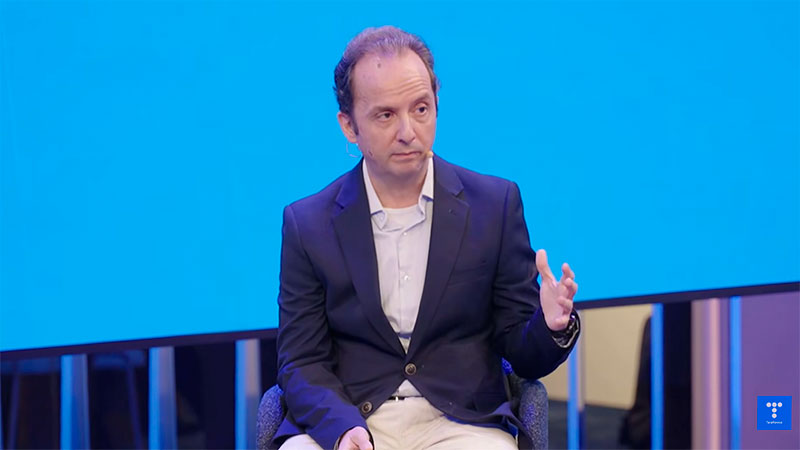 David during the session "Human and non human identity in the age of AI" at MWC 2026.
When identity scales, trust scales. And when trust scales, society transforms socially and economically.
At the systemic level, the message was clear: “Identity is not an additional service, but the foundation of digital services.” It is the layer that translates regulatory and business policies into executable controls in real time.
All identities in any environment
A central point of the keynote was the expansion of the identity concept. Today, we speak about:
- Corporate identities
- Employee and customer identities
- Citizen identities linked to digital wallets
- Non human identities: IoT devices, OT environments, Cloud workloads, software
- And increasingly, identities associated with autonomous systems and AI agents.
All of them interact across multiple systems and regulatory frameworks. Managing them as independent silos generates friction, complexity and lack of visibility.
■ At Telefónica Tech, we propose a structural approach called Identity Fabric: a fabric that connects all identities, in all contexts, under a coherent and governable model.
From reactive control to strategic core
David described the journey many organizations must undertake. In an initial stage, identity is managed reactively: a single sign-on (SSO) is implemented, MFA is added and a specific access control is deployed. “Holes are patched,” he explained.
This approach creates operational friction and focuses almost exclusively on human identities, leaving out the growing universe of non human identities and autonomous systems.
The next step is to turn identity into a strategic connector, an end-to-end enabler that allows organizations to build digital services on a common foundation.
The ultimate goal is to integrate identity into the company’s strategic decision making. To ensure that business policies are automatically translated into coherent and executable controls across all systems.
Cryptography and resilience in the quantum age
The conversation must consider the impact of quantum computing. If traditional cryptographic models are compromised, identity and trust will be compromised as well.
That is why at MWC 2026 we showcased our capabilities in advanced cryptography and Quantum Safe at the Quantum-Safe Cryptographic Hub, anticipating a scenario in which cryptographic resilience will be an essential condition for sustaining digital trust.
Scaling trust
David Prieto’s final question was straightforward: Can trust scale in an environment where human and non human identities interact at large scale?
Our answer is yes. Through Identity Fabric, we offer an approach built on four pillars:
- Comprehensive coverage of human and non human identities.
- End-to-end governance from start to finish.
- Strategic integration with the business.
- A robust cryptographic foundation ready for the post quantum environment.
In a world where AI acts with increasing autonomy, identity becomes the key element to govern that transformation.
Without a trustworthy identity, there is no digital trust. And without digital trust, there is no sustainable digital economy.
■ Build a strong identity for the age of AI -- At Telefónica Tech, we build an intelligent, interoperable and sovereign identity that offers verifiable trust in every transaction, whether it comes from a person or a machine.
Discover how our digital identity solutions ↗ can help you govern AI and scale trust across your organization.