 Cloud & Business Apps
 Cybersecurity
 Data & AI
 IoT & Connectivity
 Industry
 Health
 Banking and Finance
 Public Sector
 Retail
 Tourism and Leisure
 Transport & Logistics
 Energy & Utilities
 Smart Cities

From data to transformative impact: 11 key questions to understand the value of mobility analytics
Behind every journey lie decisions, routines and patterns that, when viewed in aggregate, reveal how our cities operate, how people behave, and where social and economic dynamics are heading. Understanding mobility beyond isolated data points has become a strategic tool to anticipate needs, optimise resources, and make better decisions.
At Telefónica Tech, thanks to our Smart Steps platform, we analyse large volumes of anonymised mobiles data enhanced by AI to offer this aggregated view of mobility, transforming it into actionable insights for urban planning, tourism management, infrastructure design and business strategy.
How can mobility data help us build more sustainable environments? What role does it play in the efficiency of public services or corporate decision-making? What kind of information can actually be extracted from the movement of millions of people? And how can all of this be done while safeguarding privacy?
Understanding mobility helps anticipate needs, optimise resources and plan with precision.
To answer these and other questions, Francisco Celeiro, Global Head of Data Solutions, addresses eleven key topics to help understand the value of mobility analytics as a driver of economic, social and environmental transformation.
- What do we mean by mobility analytics and why has it become a strategic tool?
- How does it differ from traditional sources like surveys or physical sensors?
- What specific decisions does this type of analysis enable in the public and private sectors?
- Which sectors benefit most from mobility analytics and why?
- How do we turn mobility data into actionable insights at Telefónica Tech?
- What transformative impact does it have on operational efficiency and resource optimisation?
- How is mobility analytics linked to urban and environmental sustainability?
- Can this analysis anticipate future behaviour? What value does this predictive capability offer?
- What guarantees does mobility analytics offer from a privacy and data ethics perspective?
- What conditions ensure this analysis delivers real value, not just data?
- What does our Smart Steps solution bring to mobility analytics?
1. What do we mean by mobility analytics and why has it become a strategic tool?
Mobility analytics is the process of studying how people move through a territory: where they come from, where they go, at what times, how frequently and with what recurring patterns.
More than just “counting journeys”, it allows us to understand how urban life is organised, how public spaces are used, and what needs emerge based on collective behaviour.
In a world where dynamics change rapidly —remote work, tourism, events, seasonality— having this level of insight has become a strategic tool for both public and private sectors.
2. How does it differ from traditional sources like surveys or physical sensors?
Mobility analytics complements and goes beyond traditional sources in several ways:
- Full geographic coverage, not limited to specific points like cameras or headcounts.
- Continuous data: updated daily, not just via annual or ad-hoc surveys.
- Contextual depth: enables correlation with factors like weather, events or transport availability.
- High representativeness based on real behavioural signals at scale.
- Scalability: the same approach applies to a city, a region or an entire country.
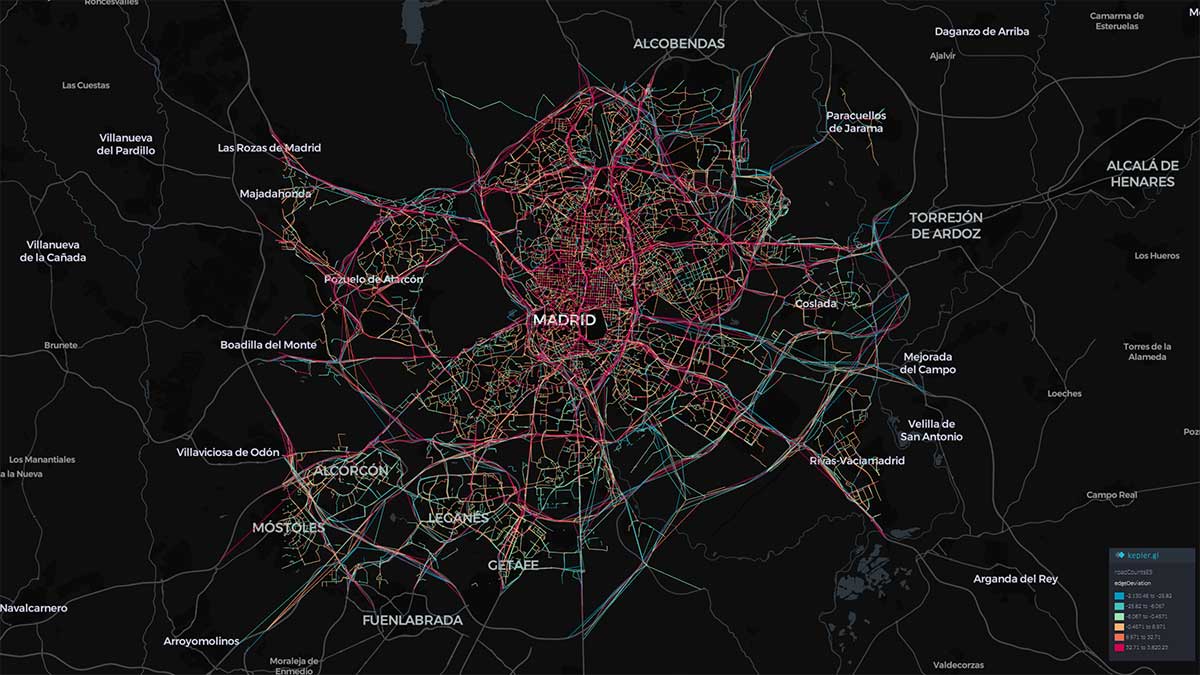 Traffic density visualisation across streets and highways.
While surveys and sensors provide a static snapshot, mobility offers a continuous film of how a territory evolves.
3. What specific decisions does this type of analysis enable in the public and private sectors?
In both public and business contexts, mobility analytics helps move from assumptions to evidence.
- In the public sector, it supports planning of healthcare, education or social services based on real usage, strengthening public transport at peak times, and anticipating crowds during events, tourism seasons or public holidays.
It’s also essential for optimising critical infrastructure such as water supply or waste collection. - In the private sector, it informs decisions such as where to open a new store, how to adjust opening hours or staffing to real customer behaviour, or how to size logistics and last-mile services precisely.
It can even be used to measure the real impact of a marketing campaign, based on physical visits to a location.
■ A strong example is the Cetaqua project in Benidorm, where mobility analytics enabled the anticipation of seasonal population peaks and real-time adaptation of water management.
4. Which sectors benefit most from mobility analytics and why?
The main sectors already leveraging it intensively include:
- Tourism: understanding visitor origin, seasonality and spending patterns.
- Retail: tracking foot traffic flows, hot zones and competition in a given area.
- Transport and logistics: optimising routes, hubs and peak demand times.
- Infrastructure: used by organisations like National Highways (UK) or AMB (Barcelona) for better planning.
- Energy and utilities: estimating consumption, network loads and maintenance needs.
- Smart cities: managing the city based on real use, not assumptions.
- Public administration: as a cross-cutting enabler across all the above sectors.
5. How do we turn mobility data into actionable insights at Telefónica Tech?
At Telefónica Tech we follow a clear, robust value chain for mobility analytics, designed to ensure accuracy and privacy protection from data collection through to practical application.
It begins with the collection of mobile signals distributed across the territory, which we process using certified anonymisation and aggregation techniques, removing any possibility of personal identification.
From this data, we apply statistical and AI models to infer mobility patterns: origin-destination journeys, dwell times, time-based flows, density and aggregated sociodemographic profiles.
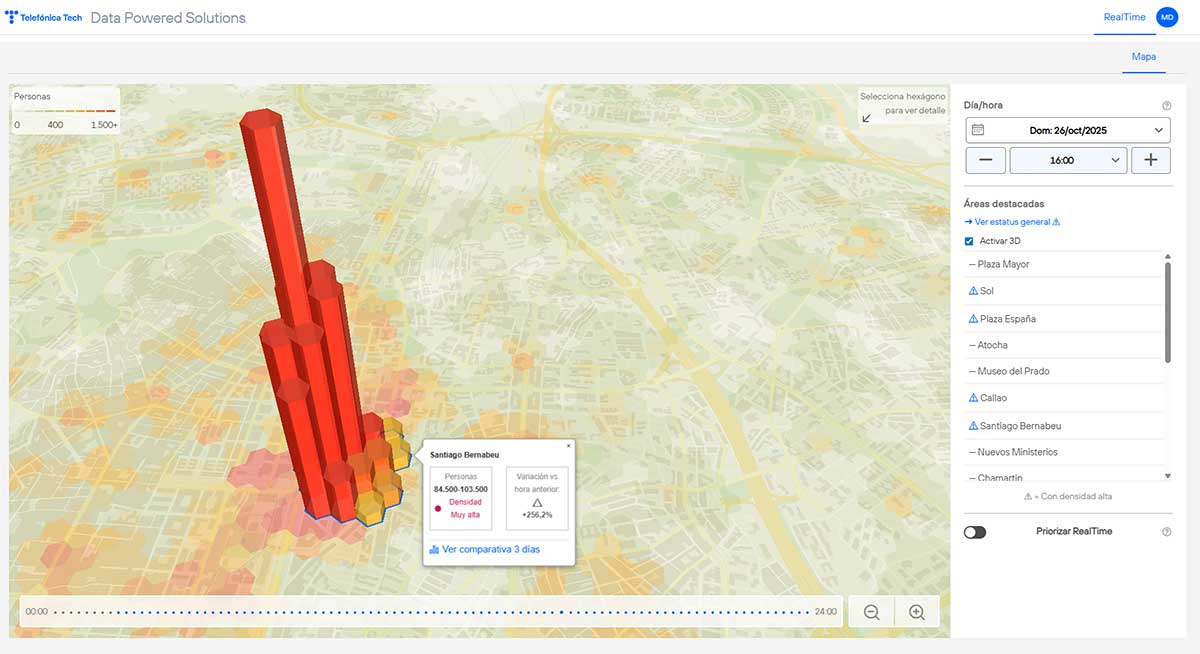 Crowd flow during the Real Madrid vs Barcelona match, Sunday 26 October at 16:15 at the Bernabéu Stadium (Madrid).
This information is presented visually via our Smart Steps platform, allowing users to intuitively explore results, generate custom reports and support both operational and strategic decisions.
Additionally, we support our clients with expert guidance and cross-reference results with external sources (such as census or official stats) to ensure analyses are representative and useful in each local context.
6. What transformative impact does it have on operational efficiency and resource optimisation?
The real impact is often immediate:
- Lower operational costs through demand-driven planning.
- Optimised staffing, routes and shift planning.
- Improved services for citizens and end customers.
- Ability to anticipate bottlenecks before they occur.
■ A well-known example is operational planning during major events like MWC, where knowing movement peaks allows precise resource preparation.
7. How is mobility analytics linked to urban and environmental sustainability?
Mobility is key to reducing emissions. By understanding when and why movement concentrates:
- More sustainable transport alternatives can be proposed.
- Unnecessary journeys can be reduced.
- Urban logistics can be optimised.
- Energy consumption linked to human activity can be more accurately forecasted and managed.
A city that knows itself can build a more environmentally efficient model.
8. Can this analysis anticipate future behaviour? What value does this predictive capability offer?
Yes. Based on time series, seasonality and historical behaviour, it's possible to:
- Forecast tourist flows 3–6 months in advance.
- Anticipate transport use or crowd peaks in specific areas.
- Predict how an event, construction or public policy might affect mobility.
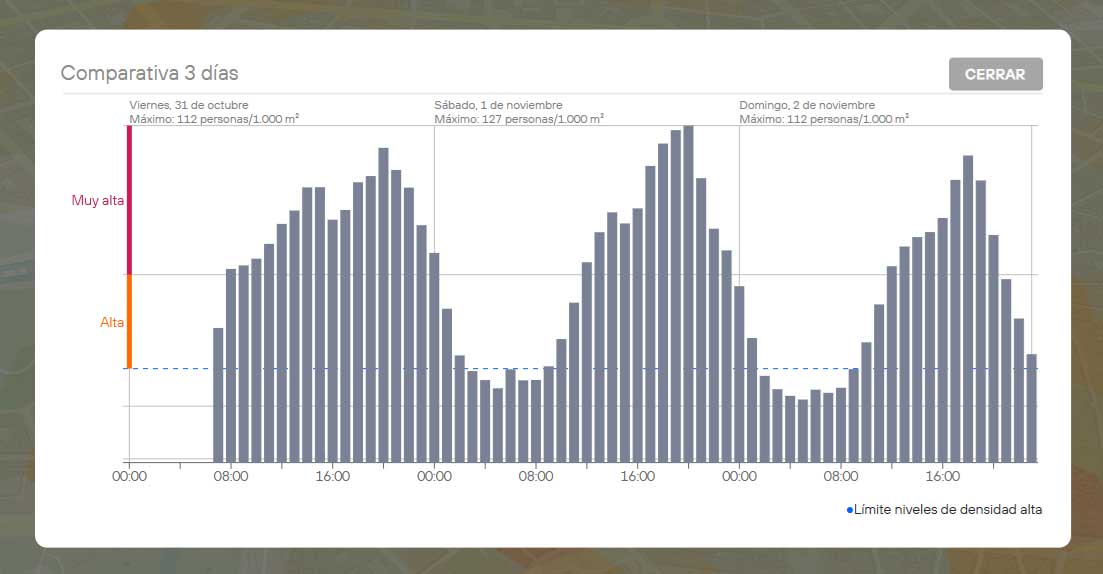 Historical mobility visualisation in Smart Steps for the same location over three days.
The value lies in acting early: preparing resources, adjusting investments and reducing risk.
9. What guarantees does mobility analytics offer from a privacy and data ethics perspective?
Mobility analytics does not identify individuals. It is exclusively based on:
- Anonymised and aggregated data.
- No direct or indirect identifiers.
- Statistical models that generate collective, not individual, insights.
Transparency and ethics are essential: a dataset that doesn’t inspire trust loses all its transformative value.
10. What conditions ensure this analysis delivers real value, not just data?
Data only creates value when:
- It is embedded into decision-making processes.
- There are clear objectives and relevant KPIs.
- An evidence-based organisational culture exists.
- Multiple data sources are combined (mobility, census, sensors).
- It is supported by expert interpretation.
Data alone informs; properly applied, it transforms.
11. What does our Smart Steps solution bring to mobility analytics?
Smart Steps is the technological solution that makes all of the above possible within a single integrated environment. Its value lies in combining technical capabilities, nationwide coverage and a clear focus on decision-making.
Its key features include:
- Continuous nationwide coverage based on anonymised mobile events.
- AI and statistical models that generate reliable patterns of origin-destination, dwell times and aggregated segmentation.
- Visual interface that makes it easy to explore insights, generate reports and export relevant data.
It’s a solution applicable across sectors such as tourism, retail, infrastructure or energy, with use cases already validated in various contexts. Additionally, Smart Steps includes expert consulting and is certified with the Eco Smart label, which confirms its alignment with sustainability and energy efficiency criteria.
.jpg "Smart Steps: understanding mobility")