 Cloud & Business Apps
 Cybersecurity
 Data & AI
 IoT & Connectivity
 Industry
 Health
 Banking and Finance
 Public Sector
 Retail
 Tourism and Leisure
 Transport & Logistics
 Energy & Utilities
 Smart Cities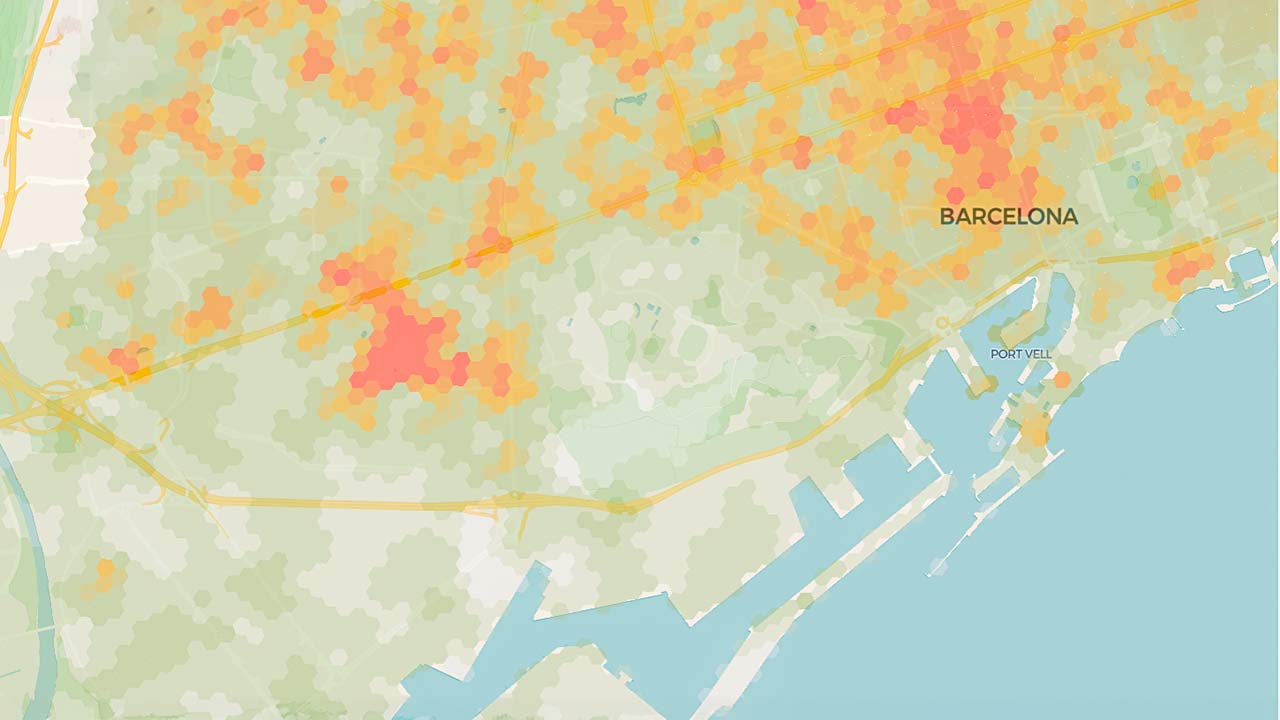

How mobility evolved at MWC 2026: what the data tells us about the event’s urban impact
Beyond its technological, economic and media impact, Mobile World Congress 2026, held from 2 to 5 March at Fira Gran Via, generated a temporary transformation in urban mobility patterns that can only be fully understood through data analysis.
At Telefónica Tech, we analysed, using our Smart Steps platform, the behaviour of visitors before and during the congress to understand how mobility in Barcelona evolved throughout the event and what changed compared to 2025.
We conducted our analysis by processing millions of anonymised data points from the outset. Aggregated analysis, using Big Data and Artificial Intelligence techniques, ensures individual privacy at all times while delivering reliable insights into collective behaviour.
Week before: stability across the city, adjustment around Fira
During the week from 24 February to 2 March, prior to the start of MWC, the total number of visitors in Barcelona remained virtually stable compared to the same week in 2025 (-0.1%). At city level, no significant increase linked to the event was yet observed.
However, in the area surrounding Fira there was a slight reduction in visitor volume (-5.8%) compared to the equivalent week prior to MWC 2025, accompanied by a 13.2% decrease in visitor volume by origin. This decline is mainly explained by the lower international presence in the days leading up to the event.
In terms of overnight stays, there was a significant reduction in international overnight stays compared to 2025, suggesting a shift in the early arrival patterns of certain attendee profiles compared to previous editions.
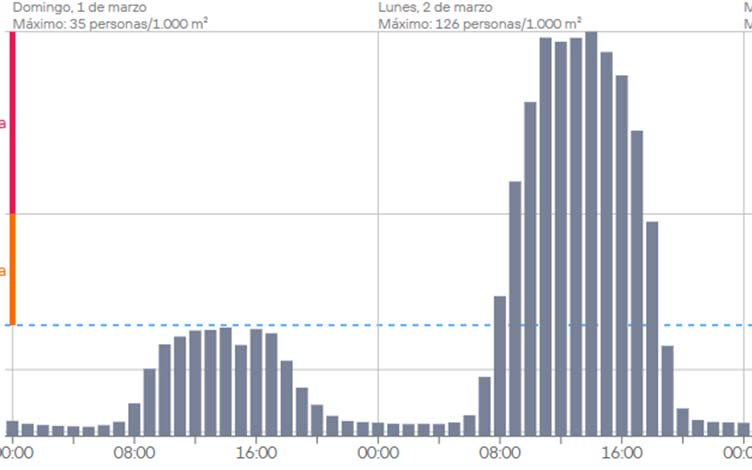 Visitor footfall by time slots during Sunday 1 and Monday 2 March 2026.
At the same time, mobility towards the venue increased by 26.1%, maintaining the typical pattern of journeys concentrated in morning and afternoon time slots, with a rise on the Sunday before the event. This behaviour points to increased logistical and preparatory activity in the days leading up to the congress.
First day: midday peak and shift towards the city centre in the afternoon
On Monday 2 March, a pattern already observed in 2025 was confirmed: most attendees arrived at the venue in the morning, although the highest attendance peak was recorded between 12:00 and 14:00.
42% of journeys to Fira were concentrated in the morning time slot. From 16:00 onwards, a gradual departure from the venue began, and it was in the afternoon when the highest volume of journeys from Fira to the rest of the city was recorded (47.5%).
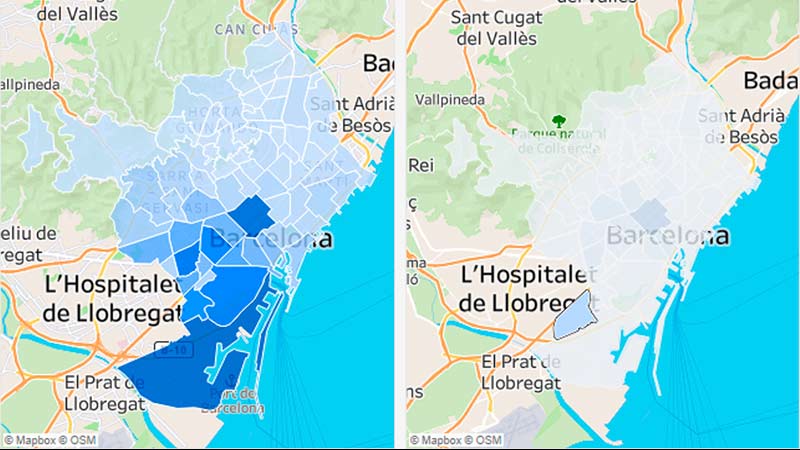 Increase in journeys to Fira Gran Via on Monday 2 March. Noteworthy is the growth in arrivals from nearby neighbourhoods and from Sants, where the main train station is located.
Overall, the pattern is similar to what we observed in 2025. However, this year reveals an interesting shift in how attendees move around the city.
In 2026, attendees tend to spend less time in central districts during the day and are more likely to arrive directly from major transport hubs such as Sants station.
■ This suggests a more direct flow of visitors towards the exhibition venue and a schedule more focused on the event itself, with fewer intermediate stops elsewhere in the city before the end of the day.
Most visited neighbourhoods and overnight patterns
After the professional sessions, mobility was directed mainly towards the city centre. Dreta de l’Eixample ranked as the most visited area in the afternoon, accounting for 17.5% of visitors coming from Fira, followed by Sants (5%).
In addition, following cultural and commercial visits, areas such as Poble-sec, Sant Antoni and El Raval accounted for around 15% of mobility from Fira during the afternoon. At night, journeys were mainly directed towards central areas such as Dreta de l’Eixample and El Raval (20%), followed by Sants and, to a lesser extent, Poble-sec (5%).
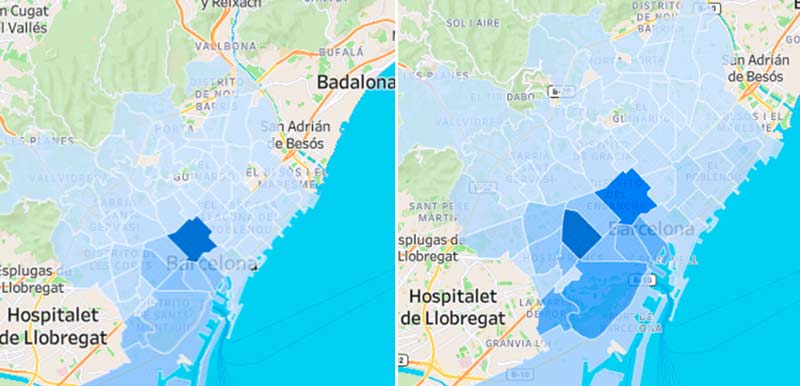 Left: The most visited area in the afternoon is Dreta de l’Eixample, a concentration point for tourist attractions and commercial areas. Right: Overnight neighbourhoods: attendees chose nearby hotels, although to a lesser extent than last year.
In terms of accommodation, central neighbourhoods once again predominated, such as Dreta de l’Eixample, while other attendees opted for hotels near Fira to a lesser extent than the previous year.
■ This pattern confirms a greater concentration of activity in central areas of the city in the hours following the event, maintaining a dynamic consistent with the professional and international profile of the congress.
International profile: global diversity with adjusted volumes
On the first day of MWC 2026, attendees from 176 countries were recorded, reflecting the global nature of the event. China remained the leading international nationality, representing 11% of international visitors, followed by Germany, France, Poland and the United Kingdom.
However, a general reduction in both international and domestic attendance compared to 2025 was observed, particularly from some of the main source countries.
Evolution 2025–2026: what has changed in the urban impact of MWC
The comparative analysis against 2025 identifies three key trends:
- Consolidation of a stable time pattern, with a strong concentration of arrivals in the morning and departures from the afternoon onwards.
- Rebalancing of accommodation towards central areas compared to the greater proximity to the venue observed at other times.
- Adjustment in early arrivals of international visitors during the preceding week.
■ Overall, these changes reflect an evolution in professional attendee behaviour: more optimised stays, less territorial dispersion during the event and greater efficiency in mobility.
Mobility intelligence to plan better
Behind every journey recorded during MWC there are decisions, routines and patterns that, when analysed in aggregate, make it possible to understand how the city truly operates during a major international event.
Mobility analysis makes it possible to identify origins and destinations, peak time slots, length of stay and territorial dynamics that reflect how economic and social activity is organised.
For public administrations and companies, this information is key to:
- Optimise public transport and reinforce routes at times of highest demand.
- Scale security, emergency and urban service operations appropriately.
- Adjust hotel supply and logistics planning.
- Anticipate peaks in activity and reduce operational bottlenecks.
Unlike traditional sources such as one off surveys or localised physical sensors, mobility analysis based on aggregated data provides a continuous, territorially broad and contextualised view, capable of linking the impact of an event with historical patterns and structural trends.
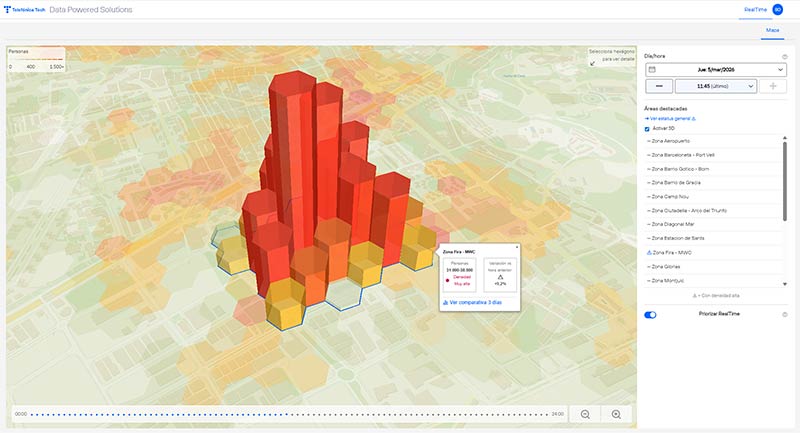 Visitor footfall on Thursday 5 at midday (11:45).
At Telefónica Tech, we transform millions of anonymised mobile signals into actionable knowledge through statistical and Artificial Intelligence models that enable us to infer origin destination flows, stays and aggregated segmentations. The result provides anticipation capabilities and evidence based planning.
The case of MWC 2026 shows how data driven intelligence enables a shift from reaction to anticipation: understanding how flows evolve makes it easier to size resources more precisely, optimise infrastructure and enhance the experience of both visitors and residents.
In a context where major events are becoming increasingly complex and global, having an aggregated and continuous view of mobility becomes a strategic element for urban and business planning.
■ To explore in greater depth how mobility analysis becomes a lever for economic, social and environmental impact, you can read our article From data to transformative impact: 11 answers to understand the value of mobility analysis, where we examine its application across different sectors in detail.