 Cloud & Business Apps
 Cybersecurity
 Data & AI
 IoT & Connectivity
 Industry
 Health
 Banking and Finance
 Public Sector
 Retail
 Tourism and Leisure
 Transport & Logistics
 Energy & Utilities
 Smart Cities

Technological innovation to drive marine sustainability
Technological innovation has transformed multiple industries over the past decades, but its role as a driver of sustainability is equally significant. At Mobile World Congress 2026, in the session Marine sustainability in action: IoT, 5G and aquatic drones against waste and microplastics, we explained how technology is a key resource to protect marine ecosystems and, in doing so, foster more responsible and prosperous economies.
Twin transitions: digital and green
Today, sustainability is a strategic necessity. For years, Europe has promoted the concept of twin transitions, where the green transition and the digital transition move forward together to address global environmental challenges. In this context, technology drives efficiency while also becoming an essential tool to anticipate and mitigate environmental impacts.
Marine pollution is an example of a challenge that requires integrated solutions: it is estimated that between 60% and 80% of marine waste is plastic, with direct consequences for biodiversity and for local economies that depend on clean beaches and healthy coastlines.
The green transition and the digital transition move forward together. Without technology, there is no effective sustainability.
Putting an end to this issue necessarily requires acting at the root of the problem, preventing waste from reaching the sea and promoting circular economy models. But while governments, companies and citizens advance in this structural transformation, it is also essential to have solutions that enable action here and now.
Sustainability with purpose: ecosystems and economy
In Spain, with more than 8,000 kilometres of coastline, environmental protection has particularly significant economic implications. Sectors such as coastal tourism and fisheries depend on healthy marine ecosystems to thrive. Sustainability, therefore, is also an investment in the future and in regional competitiveness.
This strategic approach goes beyond surface sea cleanups. It is about generating reliable environmental indicators, anticipating risks and enabling more effective decisions that integrate real time data with coordinated actions.
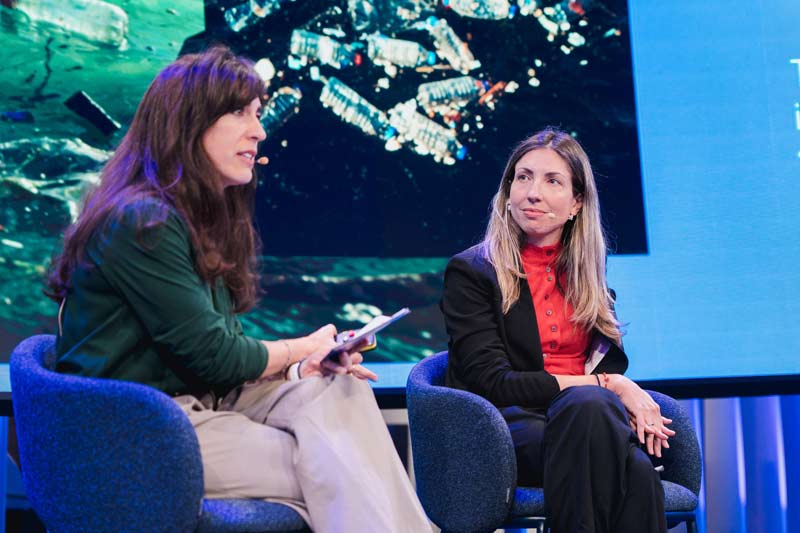 Ana Belén Pociña, Head of ESG Customer and Bussiness Development, Telefónica (left); and Kallitsa Savvidou, Head of New Business IoT, Telefónica Tech, during the session "Marine sustainability in action: IoT, 5G and aquatic drones against waste and microplastics".
Acting at the root of the problem is essential, but so is having solutions that enable us to intervene here and now.
Connected aquatic drones: another layer in the sustainability strategy
When we talk about aquatic drones, we do so from a broad perspective: it is not only about collecting waste, but about understanding, measuring and acting on the factors that determine the health of marine ecosystems.
This technological solution enables the deployment of active and integrated sustainability across multiple fronts.
During the MWC session, we highlighted that these platforms:
- Support proactive action, not only reactive responses, in marine environments.
- Generate continuous environmental data, facilitating strategic decision making.
- Help protect natural and economic assets such as beaches, ports, coastal areas and fishing grounds.
It is not just about cleaning the sea, but about measuring it, understanding it and anticipating its degradation.
Towards active marine sustainability
Technology applied to marine sustainability breaks down old barriers. It is no longer enough to respond to symptoms; we need tools that allow us to anticipate, measure and act with precision. Marine ecosystems are particularly fragile, and small variations in parameters such as temperature or water quality can trigger significant impacts on biodiversity and on related economic activities.
In this regard, connected aquatic drones represent an additional layer of action within a broader strategy that integrates public, private and community stakeholders.
This comprehensive approach is particularly relevant for collaborative projects and local partners, addressing the collection of waste and microplastics through innovative technological solutions.
A healthy marine ecosystem is not only an environmental responsibility, it is an economic investment and a guarantee for the future.
Sustainability that creates value
Marine sustainability is an opportunity for value creation. Beyond plastic cleanup, these initiatives:
- Strengthen the image and competitiveness of tourist destinations.
- Enable data driven environmental management that anticipates risks and improves planning.
- Align with circular economy models aimed at reducing environmental impact at the source and turning waste into resources.
This new paradigm requires us to adopt a holistic view of technology: innovation also means applying technology to transform the way we protect what sustains us.