 Cloud & Business Apps
 Cybersecurity
 Data & AI
 IoT & Connectivity
 Industry
 Health
 Banking and Finance
 Public Sector
 Retail
 Tourism and Leisure
 Transport & Logistics
 Energy & Utilities
 Smart Cities


From mobile mammography units to AI: how technology is strengthening breast cancer screening
Did you know that breast cancer screening is Spain's longest-running early detection programme? More than forty years ago, before automated appointment systems or electronic health records existed, women would find out that mobile mammography units were coming to their village through an announcement made by the parish priest during Mass.
A great deal has changed since then, but the objective remains the same: detect breast cancer early and reach all women. This 19 October, World Breast Cancer Day, we at Telefónica want to explain how Artificial Intelligence can help screening programmes continue to fulfil that mission.
The origins of breast cancer screening in Spain
In the early 1980s, the Spanish Association Against Cancer (AECC) began deploying mobile units across Spain, trucks and vans equipped with mammography machines, travelling across the country to reach even the smallest villages. This brought mammography to women living far from hospitals who would otherwise have found it difficult to access screening. With no centralised records or appointment systems, communities themselves played a key role in informing women: announcements were made by the parish priest during Mass or through local council notices.
Those campaigns laid the foundations for early detection in Spain. In 1983, the AECC developed an early diagnosis protocol adapted to Spain and worked with health authorities to implement it nationwide. Throughout the 1990s, screening was progressively incorporated into the public health services of Spain's autonomous communities, and by the early 2000s it had been implemented across virtually the entire country. Today, more than 70% of women aged between 50 and 69 attend routine mammography screening.
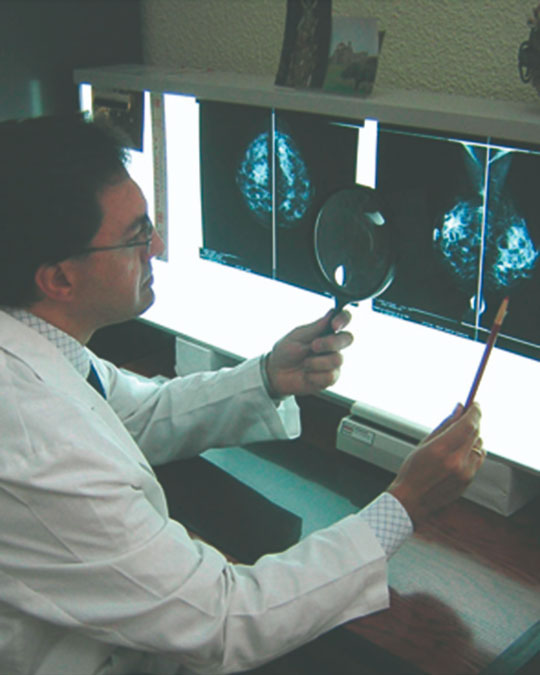 In 1983, an Early Diagnosis Programme adapted to Spain and based on international standards was developed.
Source (in Spanish): AECC blog.
Breast cancer screening was created to bring early detection within reach of all women, wherever they lived.
The most commonly diagnosed cancer in women
Breast cancer remains the most commonly diagnosed cancer among women in Spain. According to the Cancer figures in Spain 2026 report by the Spanish Society of Medical Oncology (SEOM) and the Spanish Network of Cancer Registries (REDECAN), more than 38,000 new cases are expected to be diagnosed this year.
For decades, it was also the cancer responsible for the highest number of deaths among women, until lung cancer overtook it for the first time in 2024. Today, five-year net survival for breast cancer stands at 86%, one of the highest rates among all cancers. Advances in treatment have contributed to this progress, as have early detection and high participation in screening programmes. And although it may seem paradoxical, an increase in the number of cases diagnosed each year is not necessarily bad news: as SEOM explains, an effective screening programme initially increases the number of diagnoses by identifying cancers earlier, and subsequently reduces mortality, according to the SEOM Cancer figures in Spain 2026 report (in Spanish).
But earlier detection requires considerable capacity: hundreds of thousands of mammograms every year that need to be reviewed rigorously and without delay. This is precisely where technology can make a difference.
Detecting more cancers at an early stage is key to improving survival and reducing mortality.
How AI supports breast cancer screening
Every screening programme involves an enormous volume of work. In line with European breast cancer screening guidelines, Spanish programmes use double reading: each mammogram is reviewed independently by two radiologists and, if their assessments differ, a third opinion is sought. This approach strengthens diagnostic quality, but also increases the clinical workload for radiology services that are handling an ever-growing number of studies.
This is where Artificial Intelligence can add particular value. From a technical perspective, algorithms analyse each mammogram and assign it a risk score, highlight suspicious areas directly on the image and allow worklists to be prioritised so that specialists can review the highest-priority cases first. They can also act as an additional reader within a double-reading workflow, or as a safety net that alerts radiologists when a study contains highly suspicious findings.
AI helps prioritise higher-risk cases and enhances radiologists' capacity without replacing their clinical judgement.
This does not replace the radiologist's clinical judgement. The radiologist remains responsible for validating the report, while AI provides additional information and can help them focus their time on the cases that require the most attention.
The scientific evidence in this area is already substantial. In Germany, the PRAIM study, published in Nature Medicine, evaluated AI in routine clinical practice within the national screening programme, involving more than 460,000 women. Radiologists supported by AI detected 6.7 cancers per 1,000 women compared with 5.7 without AI, representing a 17.6% higher cancer detection rate, without increasing recall rates for further assessment.
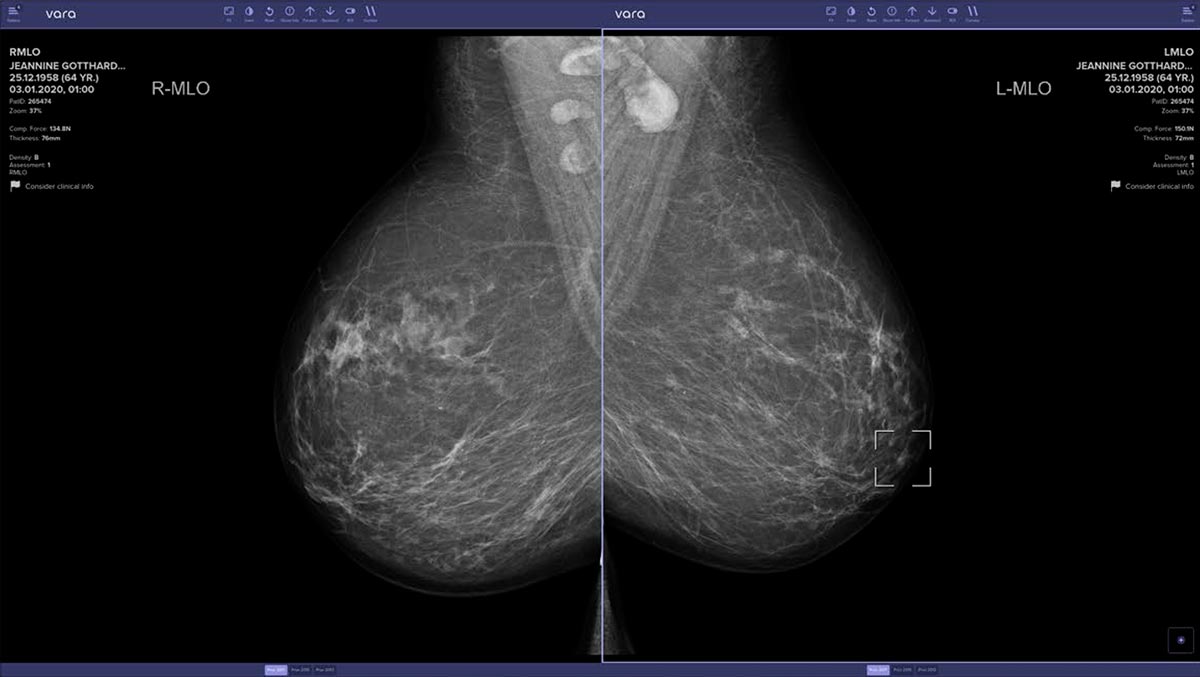 Image from the study: suspicious region highlighted (bottom right) in the AI algorithm viewer so that the radiologist can review it efficiently. Source: PRAIM study.
The result is a more streamlined and efficient screening process that can reach more women without compromising diagnostic quality. For patients, this can mean earlier diagnoses, shorter waits and less uncertainty.
■ As with any clinical application used to support diagnosis, not every AI system is suitable for clinical use. An algorithm used to support screening must be CE marked as a medical device, be transparent about the data used for training and validation and about its limitations, and allow its thresholds to be adjusted to the needs of each screening programme. It also needs to integrate seamlessly with hospital systems (PACS and RIS) without disrupting existing workflows, so that it can provide reliable support while remaining under specialist supervision.
Clinical AI only adds value when it is safe, transparent and integrated under professional supervision.
What technology cannot replace
We do not want to end this article without highlighting something essential: screening does not end when the mammogram has been read. It ends when the woman receives her result, understands what it means and knows what happens next. AI can help specialists reach more patients and help ensure that every study is reviewed, but its value lies not only in the algorithm itself. It also depends on how it is integrated throughout the care pathway and on professionals having the time to explain, support and guide patients.
The challenge is therefore not only clinical; it is also about care delivery and the human dimension. Technology can increase the system's capacity, but the trust of a woman attending a mammography appointment is earned through every conversation and every result delivered on time.
Technology increases the system's capacity, but trust is built through information, support and timely results.
Our role as a technology integrator for clinical AI
At Telefónica, we help healthcare organisations introduce clinical AI where it can add value: within real-world clinical workflows. Our role is to integrate algorithms securely and in a coordinated way into care pathways, enabling healthcare professionals to benefit from these capabilities without losing clinical control or disrupting established ways of working. We take a vendor- and deployment-model-agnostic approach, providing a single point of integration, management, operation and maintenance.
Our proposition is supported by a broad portfolio of AI-based diagnostic support solutions for a range of conditions, complemented by specialist providers. This enables us to combine clinical, technological and integration capabilities so that AI delivers value where it is genuinely needed: within the specialist's workflow and for the benefit of the patient.
On a day such as World Breast Cancer Day, we want to emphasise that technology only makes sense when it serves people. Not as a replacement for medical expertise, but as what it should be: a tool that enhances specialists' ability to detect disease earlier, treat more effectively and support patients with greater precision.
Integrating AI into clinical pathways turns its potential into practical support for healthcare professionals and patients.