 Cloud & Business Apps
 Cybersecurity
 Data & AI
 IoT & Connectivity
 Industry
 Health
 Banking and Finance
 Public Sector
 Retail
 Tourism and Leisure
 Transport & Logistics
 Energy & Utilities
 Smart Cities

The importance of mobile network data for smart management of tourist destinations
Tourist municipalities are currently facing an increasingly complex challenge: managing high volumes of visitors without compromising residents’ quality of life, the sustainability of the destination and the efficiency of public services. Seasonality, the concentration of tourists in specific areas and the need to make evidence based decisions make it essential to have reliable, up-to-date and representative information.
In this context, mobile network data has become a strategic tool to understand the real behaviour of visitors. At Telefónica Tech, we help municipalities transform anonymised and aggregated mobile network data into actionable insights that enable optimised tourism planning, improved territorial management and the design of more effective public policies.
What is mobile network data and why is it relevant for tourism?
Mobile network data or telco data is information continuously generated from the use of mobile networks. When processed in an aggregated, anonymised manner and in compliance with data protection regulations, it becomes a robust source for analysing mobility dynamics and population behaviour at scale.
Our Smart Steps solution transforms this data into key indicators through advanced statistical models and AI algorithms. In this way, we extrapolate observed patterns to the entire population to provide a representative and objective view of what is happening across a tourist municipality over any analysis period: days, weeks, months or years.
This is particularly relevant for tourist destinations, where visitor flows constantly change and traditional measurement methods such as surveys or one-off counts do not always capture the full picture.
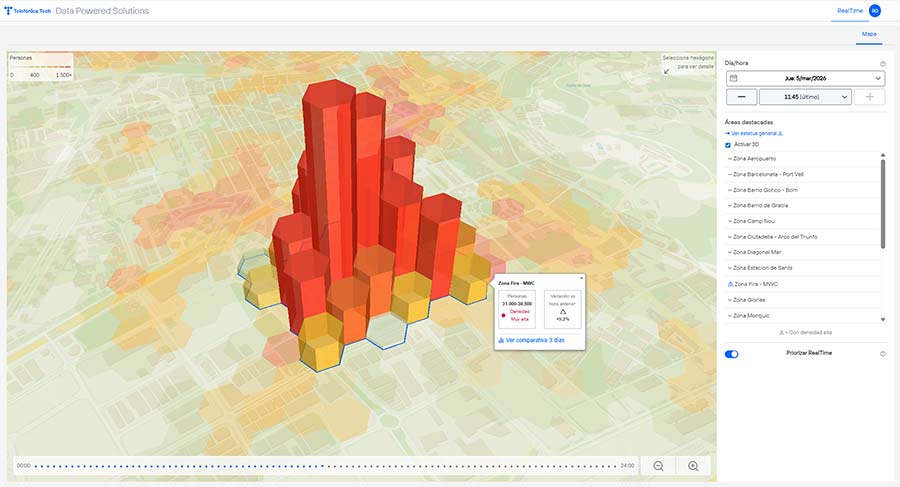 NRT (Near Real Time) view in our Smart Steps solution at Telefónica Tech
Key KPIs to understand tourism behaviour
One of the main benefits of telco data is the ability to obtain key performance indicators (KPIs) that provide a comprehensive view of tourism across the area.
Visitor volume
We can measure the number of visitors in a municipality over a given period, whether daily, weekly, monthly or annually. This indicator makes it possible to:
- Assess tourism trends over time
- Analyse the impact of events or promotional campaigns
- Identify demand peaks and periods of saturation
■ Having access to real and continuous visitor data enables administrations to make evidence based decisions rather than relying solely on estimates.
Spatial distribution within the municipality
Beyond total visitor volume, it is essential to understand which areas within the municipality see the highest levels of activity. Through spatial analysis, we identify:
- Most visited areas
- Emerging areas with tourism potential
- Spaces at risk of overcrowding
■ This information is especially useful for urban planning, flow management and the design of tourism decentralisation strategies.
Visitor sociodemographic profile
Telco data analysis can be enriched with sociodemographic information on domestic visitors obtained from aggregated external data sources. This helps to contextualise and accurately interpret network patterns, including variables such as:
- Gender
- Age
- Estimated income level
■ Understanding who visits the destination enables municipalities to adapt their tourism, cultural and commercial offering and design more targeted and effective promotional campaigns.
Behaviour and visit patterns
Analysing tourist behaviour is essential to optimise both visitor experience and destination management. Through telco data, we can analyse:
- Visit frequency
- Average length of stay
- Visitor recurrence
■ These indicators help differentiate between visitor types: occasional tourists, repeat visitors or day trippers, enabling the definition of specific strategies for each profile.
Visitors’ origin
Understanding the origin of visitors is key for tourism planning and strategic decision making. Our analytics enables us to identify visitors’ origin in an aggregated way across three levels:
- Regional visitors: residents of the same province as the analysed municipality
- Domestic visitors: residents of other provinces within the country
- International visitors: residents of other countries
■ This information supports evaluating destination positioning, dependency on specific source markets and the effectiveness of tourism promotion campaigns.
Practical applications for municipal management
The availability of these indicators enables tourist municipalities to move towards a more intelligent, sustainable and data driven management model:
Public service planning
Understanding real visitor volume and its territorial distribution makes it possible to scale services appropriately such as cleaning, transport, security or healthcare, especially during peak demand periods.
Sustainability and carrying capacity management
Tourist destinations must balance economic growth with environmental and social sustainability. Telco data makes it possible to identify areas under high tourism pressure and design measures to better distribute visitor flows, protect sensitive areas and avoid overcrowding.
Evaluation of events and public policies
Festivals, major events, promotional campaigns or new infrastructure generate changes in mobility patterns. Thanks to longitudinal analysis, municipalities can measure the real impact of these initiatives and adjust their strategies based on objective results.
Data driven tourism promotion
Understanding visitor origin and profile enables optimisation of tourism marketing strategies. Destinations can focus their campaigns on priority source markets and design proposals more aligned with visitors’ real interests.
A global view for increasingly connected destinations
Tourism is a global and dynamic phenomenon. Therefore, it is essential to have solutions that enable analysis across different territories and comparison of trends across municipalities, regions or countries.
At Telefónica Tech, we have an international presence that allows us to deliver comparative analysis and a global view of tourism behaviour. This provides a differential value for destinations competing in an increasingly digital and demanding tourism market.
In addition, the integration of AI into data analysis makes it possible to detect complex patterns, anticipate trends and support strategic decision-making in the medium and long term.
Privacy and regulatory compliance as the foundation
Responsible data management is a fundamental pillar in any mobility analytics project. Therefore, all data is processed in an anonymised and aggregated manner, in full compliance with the General Data Protection Regulation (GDPR) and applicable regulations in each country.
This means that individual behaviour is never analysed, only collective patterns. The goal is not to identify individuals, but to understand mobility, visitor flow and tourism behaviour trends from a statistical and ethical perspective.
Thanks to this approach, municipalities can access high value information without compromising the privacy of citizens and visitors.
Conclusion
Tourist municipalities need to evolve towards data driven management models that allow them to be more efficient, sustainable and competitive. In this context, telco data represents a unique source of insights into real visitor mobility and behaviour.
At Telefónica Tech, we transform anonymised and aggregated data into actionable insights that help public administrations better understand their territory, optimise resources and improve the experience of both residents and tourists.
Investing in telco data analytics not only makes it possible to understand what is happening in a tourist destination, but also to anticipate future challenges and move towards a smart destination model that is resilient and driven by informed decision-making.
■ To explore how mobility analytics becomes a driver of economic, social and environmental impact, you can read our article From data to transformative impact: 11 answers to understand the value of mobility analytics, where we examine its application across different sectors in detail.