 Cloud & Business Apps
 Cybersecurity
 Data & AI
 IoT & Connectivity
 Industry
 Health
 Banking and Finance
 Public Sector
 Retail
 Tourism and Leisure
 Transport & Logistics
 Energy & Utilities
 Smart Cities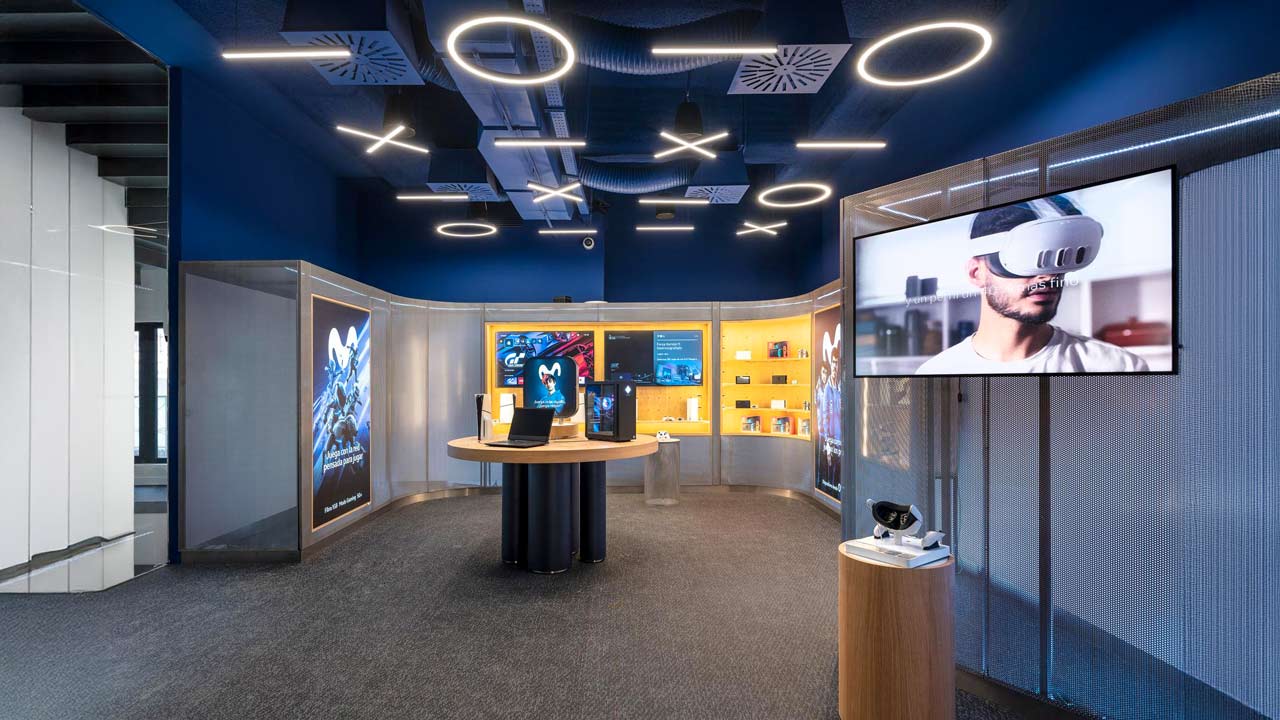

Retail 2026: the 10 trends that will transform the in-store experience (and how to adapt successfully)
2025 marked a growing adoption of AI chatbots, such as ChatGPT and Perplexity. This adoption is expected to triple over the next four years. Advances across different fields, powered by AI, show that this technology is here to stay.
Other technologies are also set to reach mainstream adoption, including robotics, virtual reality and quantum computing. In 2026, retailers will face another year of rapid technological advances, requiring organisational agility, resilience to change and a strong digital culture.
The Martec Law shows how technology evolves faster than organisations, which is why having technological capabilities in place is critical for companies.
At Telefónica Tech, we offer the technologies, capabilities and expertise needed to help our clients tackle this new challenge.
Below is our view on the key retail trends for 2026:
1. From omnichannel to omniconsumer
There are no longer multiple channels, there is only one: the consumer. Omnichannel is now a basic expectation. It must be real, and the consumer must be at the centre: this is why we talk about the omniconsumer.
Starting a purchase on mobile, trying the product in-store and receiving it conveniently at home will be the norm. Brands that connect all these touchpoints seamlessly will stand out in a context where customer time is scarce. That frictionless flow will become a competitive edge, as customers will stick with those who simplify their lives.
2. AI as the new retail back office
2026 consolidates AI as the invisible engine behind decision-making: setting dynamic pricing, adjusting product ranges by store, personalising promotions, and optimising logistics routes. On the front end, conversational assistants across websites, apps and messaging platforms solve queries, close sales, and handle incidents without friction, freeing up human teams for higher-value tasks.
The real difference won't be “using AI or not”, but how well machine intelligence is combined with human judgement.
3. Hyperpersonalisation
Access to information is no longer the challenge; the key lies in turning that data into actionable decisions.
In 2026, the retailers that stand out will be those who turn analytics into personalised products, highly relevant in-store promotions, and real-time stock alignment with actual buying behaviour. It's about adapting the product and service offer, as well as pricing, almost instantly to match customer needs.
4. Retail media and first-party data: the new business model
The Spanish retail media market is in full expansion, with predictions of sustained annual growth and revenue potential positioning it as one of the main drivers of digital advertising investment in 2026.
Retail media revenues in Spain are expected to grow by 17% annually in 2026. Retail media offers higher margins than traditional retail, which is pushing retailers to strengthen this channel in their growth strategies.
First-party data (actual purchase behaviour) becomes strategic gold: it enables unprecedented targeting precision and opens new revenue streams with higher margins than product sales alone.
By monetising their physical and digital spaces through advanced technology platforms, retailers can segment, measure and optimise third-party ad investment, generating a new revenue stream with far higher margins than the core grocery business, gross margins in retail media can be up to four times higher than the average in FMCG retail.
5. Strategic focus on sustainability and energy efficiency
Governments are demanding reduced emissions and waste, while consumers increasingly prefer and choose more sustainable brands. Environmental and social awareness will continue to grow, and consumers will favour brands that demonstrate genuine commitment, not just messaging.
Recyclable packaging, in-store energy efficiency and responsible supply chains will become expected standards. The challenge will be to prove that profitability and sustainability can go hand in hand. Companies will need to transparently communicate their actions, as customers will want to know how their purchases are making a positive impact.
The European Union has set a demanding roadmap to 2030 for greater sustainability and energy efficiency. Retailers will need to adjust operations to ensure packaging is recycled and to justify the reuse of recycled materials. Companies with low ESG ratings may face penalties or struggle to secure funding in future.
'Reverse vending' systems for returning plastic packaging will become increasingly common in retail.
Responsible energy use is another key focus area for the EU. Higher energy consumption means higher CO2 emissions, and energy is also a geopolitical resource the EU seeks to protect.
Retailers will face two objectives: compliance with regulations and reduction of energy costs to gain a competitive advantage. Energy Management Systems (EMS) for monitoring and controlling energy use will become increasingly common across retail.
6. Instant gratification with ultra-fast delivery
Millennials and Gen Z live in real time and don't want to wait. Many digital platforms are creating urban ecosystems, partnering with local stores and restaurants to digitise them and fulfil orders from their platforms with ultra-fast delivery. Smart lockers are on the rise to speed up and control deliveries.
We live in an increasingly fast-paced world. Not long ago, waiting for a website to load was normal and today we consider it digital prehistory. The same mindset now applies to the physical world: customers no longer tolerate waiting for products they've purchased, and delivery times and methods have become key factors when choosing one store over another.
In 2026, smart locker systems will continue to expand, making product delivery faster and more convenient.
7. Restructuring logistics and manufacturing
Retailers with international operations will need to rethink their logistics and manufacturing strategies to minimise the impact of current and future geopolitical changes on end customer pricing.
Adopting Big Data and AI will help companies make better, faster decisions.
8. Cybersecurity
Cyber-attacks against businesses, including retail companies, rose significantly in 2025, and this trend is expected to continue in 2026.
Cybersecurity has become critical, and a lack of security measures can lead to millions in losses, service outages, or in extreme cases, business shutdowns.
9. Automation is transforming the sector, but human value is rising
The retail robotics market is expected to reach $76 billion by 2029 (ComCap), while artificial intelligence is being integrated into inventory management, customer service and data analysis.
However, this digitalisation doesn’t replace the human factor: it enhances it. While 52% of tasks are automatable, time spent on interpersonal skills is set to grow significantly (McKinsey Global Institute).
In a more automated world, the real scarcity is talent that can understand the customer, interpret data and drive change. 2026 will require greater investment in upskilling. Retailers that invest in the employee experience (training, purpose, autonomy) ultimately deliver a better customer experience.
10. Stores as spaces for inspiration and community
The physical store will evolve into a space designed to inspire, engage and build community, with hybrid experiences that blend entertainment, education and social connection.
Stores no longer need to sell in order to matter: they invite people to stay, not just pass through. Increasingly, retailers will integrate food, culture, leisure and beauty zones to foster community and create stores where things happen, where people live experiences.
Conclusion
The retail landscape in 2025 and the outlook for 2026 point to a scenario filled with major challenges and opportunities. Digitalisation, the rise of retail media, the growing importance of cyber security and automation demand continuous and strategic adaptation from businesses.
In this context, partnering with strong technology providers is essential to turn challenges into competitive advantages and deliver a superior customer experience.
■ At Telefónica Tech, we position ourselves as a trusted technology partner to support companies in the integration of innovative solutions, helping them address today’s challenges and fully seize the opportunities in the evolving retail landscape.